We are rational, individual entities because we are self-conscious, can reason, and have dominion over our actions. How can we retain such dominion by outsourcing our rational powers and decision-making to contraptions? What can be the incentive for the masses to engage in the habits of rational exercise? Alexis de Tocqueville saw clearly that liberty grows only if we preserve it by our actions. “Nothing is more fertile in prodigies than the art of being free; but there is nothing more arduous than the apprenticeship of liberty.” We would be foolish to think that our rationality, and thus our humanity, will not suffer by surrendering its exercise.
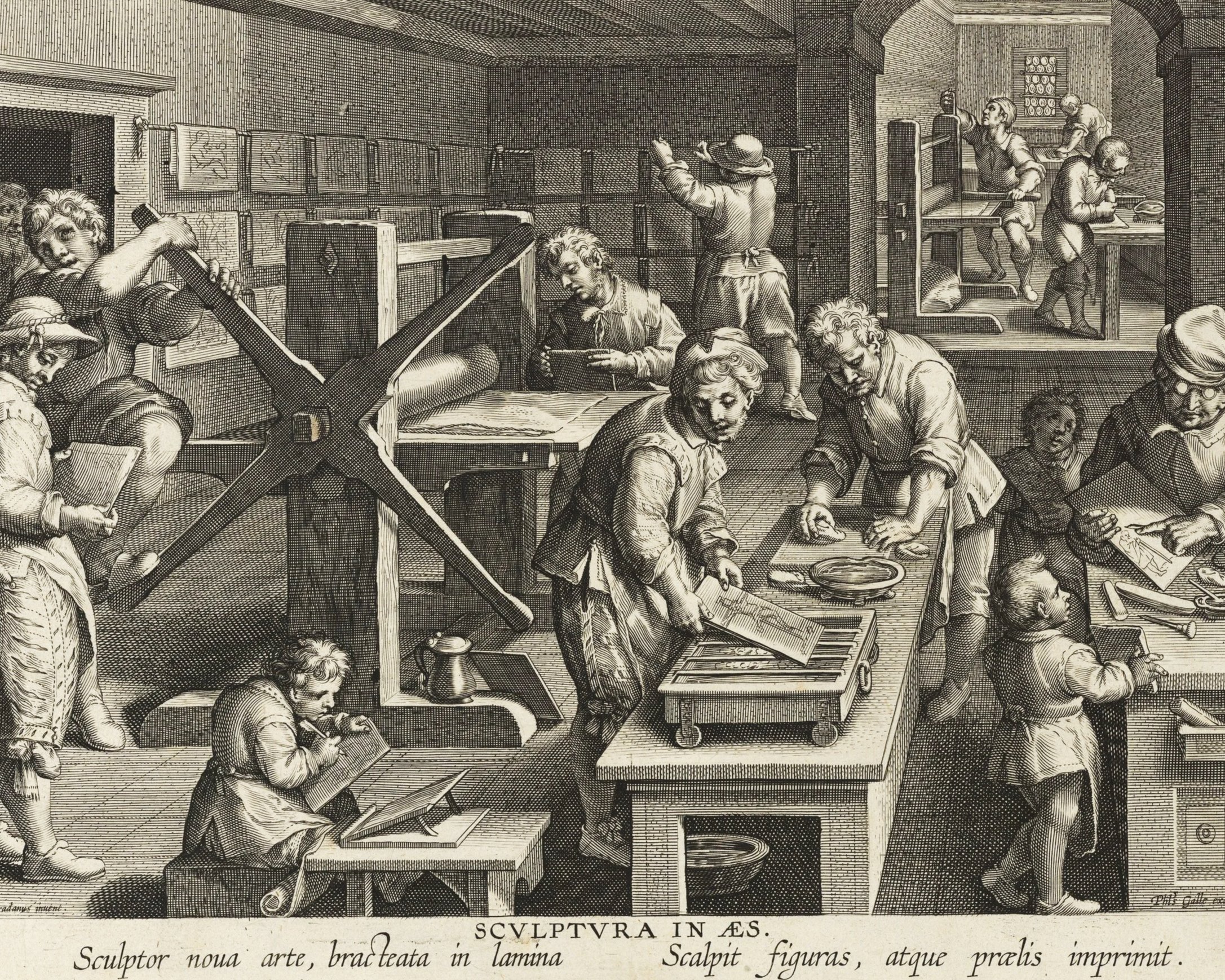
Jan Collaert, New Inventions of Modern Times [Nova Reperta], The Invention of Copper Engraving, plate 19, engraving, ca. 1600 (Photo: The Met)
“What is man that You are mindful of him,
And the son of man that You visit him?”
—Psalm 8:4
What does it mean to be human? This anthropological question challenges us in a world of rapidly advancing methods of artificial intelligence (AI). We cannot allow the question to be seen as esoteric or secondary. If it remains peripheral, we will reach a point of no return where a particular vision of the person is affirmed without a challenge, as if it were obviously true and a necessary building block of an overlapping consensus.[1] Various answers exist, each with serious implications that may enhance our lives or make them dauntingly irrelevant.
One answer tells a story of eternal matter and atoms in constant fluctuation. All natural phenomena are explained in terms of matter and motion. A peculiar manifestation of these atoms is called genes. These specific sequences of DNA act as blueprints for the formation and multiplication of proteins. After long periods of time, some of these genes organized into what we call human beings. This term does not convey anything essentially exceptional; it merely highlights a particular atomic arrangement. Human beings are ultimately a physical and chemical configuration created by “selfish genes” built into “survival machines.”[2] Cofounder of OpenAI and leader of that technology’s revolution, Ilya Sutskever, tells us that “the brain is a biological computer.”[3] This understanding offers a mechanistic view of human beings: what is “artificial” in AI is only our saying so.
But why “selfish genes”? Psychologist Steven Pinker notes that science often uses anthropomorphic language to describe biological necessity. Genes are not selfish; they simply are. In Pinker’s view, morality is ultimately a product of evolution. Both altruism and selfishness can aid survival, so morality may be little more than a collective illusion. Its origin is neither in the mind of God nor in Platonic forms up in the sky. Perhaps we are born with a rudimentary moral sense that later develops for our survival. Or it may be that morality arises from rationality itself, independent of the reasoner’s subjectivity. In any case, Pinker concludes that morality emerges from biology and is shaped through cultural experience, which we refine through reason and language in the name of “moral progress.”[4] Creatures struggle against each other in savage competition to benefit from resources in a world plagued by scarcity. In that struggle, we developed a notion of self-importance to protect our genes. We called it dignity. Yet, what is real is that the strong survives and the weak perishes. Progress cannot obtain, only change, and there is no ultimate meaning to life besides such impetus for survival. There is no space between stimulus and response, only chemicals mimicking the substantial.[5]
“Man, you were not born for death but for life! And technology must abide in life and never eclipse the voice of man, as that voice is the herald of the gift.”
The evolutionist model acknowledges only one segment of the Cartesian split,[6] the natural world, but moving from this scientistic vision we find another notion, which in part recognizes the brute fact of material existence yet sees that world of matter and motion as the world of “facticity.”[7] Material existence is just there but cannot be accounted for in understanding reality. In the existentialism of Jean-Paul Sartre, facticity is a burden, an aspect of reality to overcome. Matter and motion pair with the world of societal and cultural norms as brute facts in need of shattering. The central claims of existentialism posit that meaning and purpose are constructed by acts of choice against facticity and against the hell that other people are.[8] The mere fact of being, of existing, precedes the value that comes from individuals creating their own meaning and identity in a war with others who are also attempting to actualize their freedom, often at our expense.[9] In Martin Heidegger’s philosophy, facticity becomes what he called “thownness,” referring to all the preexisting historic, social, and cultural conditions that precede our coming into being.[10] Yet, as all things in the material world exist in their most basic sense, they can become bricks in building our teleological house. This thrownness is a fundamental aspect of our existence, utterly not of our doing, but not necessarily our destiny either.
Everything has a genesis bereft of meaning.[11] Before we are, there is raw matter, existing in solipsistic silence. Our body is relatively extrinsic to us and only the directiveness of consciousness reveals any meaning. However difficult it is to explain what consciousness is and how it relates to the body, consciousness exhausts what we call identity and may enjoy only a proximate semblance of purpose. All we know is that such a teleological thrust does not survive the brute fact of material existence. We are a “thinking thing,” a ghost inside a machine, and we possess freedom.[12] In expressing ourselves in the world by thinking and acting, we build ourselves from little more than the Kantian a priori forms of cognition.[13] The human self is an achievement instead of a metaphysical substance.[14] René Descartes’s dictum aptly summarizes this view: Cogito, ergo sum, “I think, therefore, I am.”[15] It is in the mental construction of a self and in the pursuit of projects in the world that we become beings with proximate purpose. Different existentialists perceive the form of that challenge differently,[16] leading either to a struggle of man against man, nihilistic angst, rebellion against reality, or social cooperation.[17]
Our best hope under this paradigm seems to be Nietzche’s “active nihilism,” a destructive but essential endeavor to reconfigure ourselves in the face of seemly inevitable despair.[18] That realization ought to mobilize us to create our own values, becoming an “overman.”[19] But there are dangers. In the construction of self, power has the most important instrumental role. Oppressive forces attempt to determine destiny and identity for the masses, as the herd mentality manifests itself. These forces impose a meaning on the facticity of material existence to impede the realm of freedom. They use “social law” to imbue the body politic with meanings that perpetuate oppression. To the mute raw content of matter, they add a meaning that gives rise to ideas appearing to align with reason. People learn about their place in that continuum of oppressive social existence in the culture and, by imposing meaning on things, some become oppressors of those destined to accept the way things are, the oppressed.[20]
Under the influence of postmodernism[21] and neo-Marxism, the existentialist response took yet another turn in the 1960s. In the new system, often called Theory, the facticity of existence disappears completely from any ontological explanatory account. This is Parmenides’s notorious understanding reformulated. As everything other than discourse is nonbeing, it can cause nothing.[22] While previous existentialist philosophy gave preeminence to human action over the fact of extended matter, the new turn erases matter as relevant to the definition of being. Everything is given in discourse.[23] Nothing is pre-discursive in this new Idealist[24] and monist[25] construct. What is left is a requiem to Cartesian extended matter, as even our bodies are an instantiation of discourse. As discourse is everything, rationality and science[26] are merely constructs, tools of the oppressor.[27] As a radical derivation from a long skeptical journey (whose main exponent might be David Hume), there is no basis to believe anything. Longstanding boundaries—those between truth and falsehood, good and evil, art and science, objective and subjective, and real and unreal—must be challenged with derision and erased.
Our selves are fractured and devoid of meaning until those in power impose a narrative of purpose as if it were objective truth. Any philosophical account that holds anything as pre-discursive, including existentialist and Kantian accounts, presents an illusion.[28] There is no adaptation[29] to much of Heidegger’s thrownness. What are we, according to this paradigm? We are at once nothing specifically (as quiddity is absent), and also anything our hearts desire. The rejection of rationality risks losing the vitality that our thought processes provide and that has led, or so we thought, to major breakthroughs for the good of humanity. These achievements did not come from a wishing well that instantiates desire but from the trial and error and the messiness of reason and experience by embodied selves.
As the new radicalism moved in time, it changed again; after all, if postmodernism is anything, it is an always-shifting hurricane. Something happened to postmodernism as it suffered from a sort of utopian syndrome.[30] Angst and despair often immobilize,[31] but they can also activate people within movements that promise the advent of a state of ecstatic wonder. Neo-Marxism contributed an impetus toward revolutionary change absent in postmodernism, rescuing it from its passive nihilistic desperation and disillusionment and instrumentally serving the cause of deconstructing almost everything. In the 1980s, radicals aligned with the postmodern paradigm rebelled against its being just a howl into the darkness of meaninglessness; they wanted something actionable. What was actionable was a move against oppression. But if oppression was real, the target of oppression ought to also be real.[32] Activists and intellectuals reified the knowledge and political principles of postmodernism by rejecting skepticism in one area of life: the struggle against oppression.[33] At least that must be rescued from the erasure of facticity.[34] The identity of victim could not be merely illusory or the product of discourse. What was real was a given matrix of oppression in a long list of elements joining social class at the floor of reality.[35] We are a race, a gender, an identity, cried the social justice warrior. The case might be that we are identities embodied in flesh, whose destiny and identity are exhausted by group consciousness.
We must insist on our prior question: What are we? Are we collections of atoms in eternal random reconfiguration, particles devoid of meaning? Are we conveyances for genes in savage struggle with others to survive? Is our sense of autonomy and subjectivity an illusion created by brains shooting hormones in constant chemical interactions? If we are just that, AI technology possesses no moral conundrum, because it is yet another atomic configuration, another vehicle or mechanism for genes to extend their existence and project into the future.
Instead, maybe we are disembodied thinking things in brute war against the thrownness of existence and in eternal struggle with the brutish hell caused by others. Now, there might be another alternative within the same paradigm. If de Beauvoir was correct, we are disembodied freedoms with the sole goal of projecting our autonomy in the world in collective solidarity as we rebel together against the forces of facticity and oppressive social laws. If that is the case, any weapon of war fits. In both cases, finding no inherent meaning in an indifferent universe, we journey while casting into the world our quest for a self, one that is patched together to create an identity without a preordained destiny or cosmic purpose. In this case, any utilitarian tool suffices. After all, aren’t we our own gods who create ourselves and our tools? AI is another incantation of discourse, and as such there is nothing to fear but its falling into the hands of oppressors. Aren’t we radically free in the sense that any boundary, even that of a nature, is an imposition?
It seems that, as with any project, AI is nothing but an instrument or an opium helping us to face the weight of death’s finality. It is an instance of the total freedom we seek, where anything goes, placing us at the center of what in the end will still be inescapable eschatological ruin.
Or, might it be the case that we are what Judith Butler says, fractured selves, ideas in minds, trying to erase the lie of the normal? The question of identity disappears, as we build and deconstruct ourselves at will in a strange and turbulent world of nonrational impulses devoid of any category. Breaking from the very mechanisms that make us human, at least as our intuition tells us, we rebel against everything by blurring all boundaries. If our ideas are instantiated through words and build us, they must be understood as seeing the world in fundamentally different ways, where everything is possible. It could be that we are inside a simulation, pieces in a puzzle being completed by other beings.
In the pursuit of total freedom pursuing reconstruction, we can decide to merge ourselves with machines and transcend biological constraints using the new thing we call AI. Normativity being the enemy, who can place a boundary? The consequences of this merging could be disastrous. Instead of shaping AI to complement our minds, it could be that technology enables yet another deconstruction, reshaping us in its own image. Technologies serve no given vision of man and must reflect the very incomprehensive nature of the radical distrust that informs postmodernism. It could be that AI must be completely deconstructed from being intelligence at all, as the term is yet another construct. Can AI be queered?[36] AI is then an episode in the play of what Albert Camus called “the Absurd.”[37]
Jesus once told a parable of a son alienated from his father. Coming to his senses while in the famine of a wasted life, he determined, “I will set out and go back to my father and say to him: Father, I have sinned against heaven and against you” (Luke 15:18). Maybe we need to retrace our steps to rediscover the truth that informs our existence. The anthropological narratives we have briefly traced may be where we squandered our wealth in wild living (see Luke 15:13). Maybe the experience moves us to look further to an ancient but perennial and noble narrative. It is the narrative against which most modern philosophy rebelled. The Christian tradition that shaped Western civilization tells the tale. In it, the voice of a shifting discourse determined by power does not constitute the floor of reality. Instead, we begin with you and me and all the things in this world as real things, as substances.[38] We begin with human beings also as subjects,[39] with inherent qualities allowing us to act of ourselves. In this general complexion, these qualities exist in us, really existing in a pre-discursive fashion. Discourse only describes the subject. The conviction that animates this narrative is that our instincts are not fooling us to believe in a world imbued with meaning and purpose. Aspects of this teleological world are discoverable a priori by reason and through experience because humans as “individual substances of a rational nature”[40] can discover them. This paradigm of certainty allows us to see that there is an order in nature. Our practical cognition can arrive at propositions or precepts that are true because there is something there to explain. We are unified beings, organisms with a body that is personal and a soul (consciousness) that is not foreign to flesh. There is nothing to throw away; res cogitans and res extensa are united as a single fundamental substance.[41]
Deep within ourselves there is a spark of inherent worth whose counsel illuminates our senses to grasp its beauty. Its marrow is not a passing thought but a great tiding of ultimate intentionality. Yes, what is there correlates with our images. To say that each thing in the world is teleological is to say that it has a destiny, that progress is possible, and that there is an expectation of integral fulfillment. We call this interior quality of being a nature. In human beings the inner activity or vital function of rational activity is what makes us human and distinguishes us from other animals.[42] From an order in nature, we can discern an order in the mind to understand the person. In a broader and ultimate layout of causality, that order in nature is not at the base of reality, as that would give us the survival machine. An order in nature speaks of an order in the mind of God, the great wellspring of all meaning and purpose. God made human beings capable of exploring the details of the order of things, and a system that engages such exploration is a natural law one.
As the source is the cradle of all that is good, our anthropology is the history of love giving birth to all that it touches. We had a beginning, and we have a destination. We are a gift to each other and owe reverence to every countenance. Man, you were not born for death but for life! And technology must abide in life and never eclipse the voice of man, as that voice is the herald of the gift. Technology must be at the service of man. Machines must remain subordinate to their creators. This reality entails a great horizon of possibilities but also boundaries of directiveness.
Hegel was onto something with his dialectical master-slave story of the meeting of two individual consciousnesses. Each sees itself as the only objective standard, his life validated against all others. Yet, meeting the contender forces a rivalry—one with life-and-death repercussions. The victor will gain recognition and social validation, while the other must endure the degradation of servile existence. Each self-consciousness must mightily struggle in order to realize and perpetuate its strength in relation to the other. Yet, ironically, the superior status of the master brings about complacency. In the boredom of his affluence, he disengages from the struggles of life that allows for growth. In the meantime, the slave develops skills, practices virtues, develops self-reliant habits, and, through labor, becomes interiorly free. The struggle ends when the master, though still in control, finds his status dependent on the recognition of the slave to retain his being, to maintain his self-awareness. The synthesis in Hegel ends with a mutual recognition at a higher state of consciousness: self-consciousness. Freedom is gained by overcoming dominance through labor.
We seem to find ourselves in a somewhat similar struggle but between one consciousness and an artifact mimicking it.[43]O One consciousness has an inherent status but finds itself in mortal combat with his own creation. By surrendering his higher status to the artifact, it transfers the struggle inherent to its condition to the other, giving power as if from the outside to an artifact that lacks such inner strength. The artifact cannot labor, as this is not in its essence, but it is made stronger by the dereliction of consciousness. In the end, the confrontation cannot end in Hegel’s mutual recognition, as there is no intrinsic similarity at play. Yet, the master soon finds himself the slave.
We are rational, individual entities because we are self-conscious, can reason, and have dominion over our actions. How can we retain such dominion by outsourcing our rational powers and decision-making to contraptions? What can be the incentive for the masses to engage in the habits of rational exercise? Alexis de Tocqueville saw clearly that liberty grows only if we preserve it by our actions. “Nothing is more fertile in prodigies than the art of being free; but there is nothing more arduous than the apprenticeship of liberty.”[44] We would be foolish to think that our rationality, and thus our humanity, will not suffer by surrendering its exercise.
Endnotes
[1] The concept was developed by philosopher John Rawls in his influential book Political Liberalism (Columbia University Press, 1993; exp. ed., 2005). Here I use it to showcase how agreement on a shared core of political and social positions is generated, purportedly based on widely accepted principles. When we examine Rawls’s presentation as one that transcends and overcomes differences in political, religious, and philosophical beliefs (“comprehensive doctrines”), we find that a given comprehensive doctrine has ruled the day throughout the process: “comprehensive liberalism.”
[2] See Richard Dawkins, The Selfish Gene (Oxford University Press, 1976; 4th ed., 2016).
[3] Quoted in Iddo Gefen, “The Human Brain Doesn’t Learn, Think or Recall Like an AI. Embrace The Difference,” Los Angeles Times, July 9, 2025,https://www.latimes.com/opinion/story/2025-07-09/human-brain-artificial-intelligence-model.
[4] “Far from debunking morality, then, the science of the moral sense can advance it, by allowing us to see through the illusions that evolution and culture have saddled us with and to focus on goals we can share and defend.” See Steven Pinker, “The Moral Instinct,” The New York Times Magazine, January 13, 2008, https://sites.nd.edu/cstresearch/files/2013/07/Pinker-The-Moral-Instinct-New-York-Times.pdf.
[5] Perhaps no one has better described the meaning of human life within the evolutionary and scientistic worldview than Pinker:
The scientific outlook has taught us that some parts of our subjective experience are products of our biological makeup that have no objective counterpart in the world. The qualitative difference between red and green, the tastiness of fruit and foulness of carrion, the scariness of heights and prettiness of flowers are design features of our common nervous system, and if our species had evolved in a different ecosystem or if we were missing a few genes, our reactions could go the other way. Now, if the distinction between right and wrong is also a product of brain wiring, why should we believe it is any more real than the distinction between red and green? And if it is a just collective hallucination, how could we argue that evils like genocide and slavery are wrong for everyone, rather than just distasteful to us?
Pinker, “The Moral Instinct.”
[6] In modern times the notion of man as a purely biological reality grew out of the French philosopher René Descartes’s dualistic view whereby a “thinking thing” is united with extended matter.
[7] The term first appears in the works of nineteenth-century Prussian idealist philosopher Johann Gottlieb Fichte to describe the contingent objects of experience. In the neo-Kantian rendition, it was used to describe those aspects of existence that cannot be explained or accounted for.
[8] The line “Hell is other people” (L’enfer, c’est les autres) comes initially from his 1944 play No Exit. In the play, three characters wake up in a room in eternal confinement. The point of the story is that we are social creatures of necessity, but that reality has a dark side of insecurity. The punishment of the three men, and that of us all, is the constant awareness of each other’s judgments, insecurities, and perceptions.
[9] These views were incipient in neo-Kantian and idealist philosophy and in the works of the purported father of existentialism, SørenKierkegaard.
[10] “Thrownness” is first used in Heidegger’s Being and Time to describe Dasein’s passive coming into being. See Katherine Withy, “Thrownness,” in The Cambridge Heidegger Lexicon, ed. Mark A. Wrathall (Cambridge University Press, 202), 753–56. Dasein is a term used by Heidegger to explore human existence as a unique mode of being.
[11] Things are deprived of meaning because we can know nothing about the world “out there.” In his Critique of Pure Reason, Immanuel Kant refers to the chasm between the rationalists and the empiricists. The rationalists affirmed the existence of universal truths knowable a priori, also referred to as synthetic a priori truths. The empiricists affirmed that nothing is knowable before experience. Initially a follower of the rationalism of Leibniz, Kant eventually partially agrees with the empiricist Hume: there are no universals apart from particulars. Yet, rejecting Hume, knowledge is not merely cultural, as there is a principle within us that structures the mind. The world outside our minds must match the categories in our minds so that we can make sense of it. What the world really is, we do not know. All we know is how our mind structures the objects of phenomena.
[12] For Sartre freedom is existence as being. Freedom, the greatest blessing yet a burden, is what creates us as teleological beings. We are “condemned to freedom”—that is, to the task of giving meaning to our existence and moving from facticity to substantial life. Freedom is the absolute capacity to, in creating our own hierarchies, build ourselves from the nothingness of matter. The burden of responsibility is the essence of existence. See Sartre’s 1946 lecture “Existentialism is a Humanism,” in in Existentialism from Dostoyevsky to Sartre, ed. Walter Kaufman (Meridian, 1989).
[13] A priori forms of cognition are the organizational principle that organizes and reveals experience. They are independent from the input coming from our senses, as they create images of the external world. These images travel to our brains, where they are classified. They are like the “Hello Girls” telephone operators of the early twentieth century, plugging cables into switchboards.
[14] There are Hegelian reverberations in the existentialist notion of a world “out there” lacking meaning. In Hegel’s idealist system the achievement of a self is a historical one, instead of being merely personal. The laws of history are the laws of freedom. We are parts of an overarching spirit progressing toward full knowledge of self. In the struggle of dominating ideas against their opposites, we move toward higher states of consciousness, achieving it from one era into another in an eschatological thrusting forward.
[15] This exact phrase first appeared explicitly in Descartes’s 1644 work, Principles of Philosophy. Yet the gist of the phrase is present first in French in part 4 of his 1637 Discourse on the Method, and later in his second meditation in Meditations on First Philosophy, using the phrase “Ego sum, ego existo” (“I am, I exist”).
[16] For example, Kirkegaard’s rendition places greater emphasis on a sort of Hegelian historical process for the Geist to unfold and progress. Contra Sartre, Kirkegaard sees the process of becoming as a sort of biological and historical inevitability. Becoming is synthesized with “accepting” what is given. Later we shall see how in the postmodern and neo-Marxist rendition nothing is given. See Anthony Rudd, Self, Value, and Narrative: A Kierkegaardian Approach (Oxford University Press, 2012).
[17] Sartre and Schopenhauer were proponents of the ontological struggle paradigm. Albert Camus is the best example of the rebellion paradigm. Simone de Beauvoir is paradigmatic of the social cooperation model. Others, like Kierkegaard and Nietzche, warned against nihilistic despair.
[18] Or perhaps it is Simone de Beauvoir’s departure from Sartre’s pessimism by focusing on the temporal meaning of the projects we engage, particularly clear in her The Ethics of Ambiguity (1948).
[19] See the prologue to Nietzsche’s Thus Spoke Zarathustra. The overman is the human condition of anchoring our existence, joy, and hope in material reality. In doing so, we create ourselves by rejecting traditional morality—seen as “herd mentality”—and refusing to become the “Last Man,” complacent in comfort and entertainment. The overman courageously confronts his finitude and the truth that there is no afterlife. In doing so, rather than descending into bitterness and despair, the overman learns to accept and even love his fate (amor fati). The overman is driven by a will to power, that is, a thrust toward self-mastery.
[20] Both Hegelian and Marxist views are merged in various existentialist renditions. The oppressor is the one who imposes meaning (Geist) on things, and the oppressed are those tied to the meaning given, in a sense becoming property. The advent of a private property–focused economic system facilitates the use of meaning to oppress. Women, for example, are tied to the facticity of their sex as men define them by the fact of giving birth to new flesh. They become breeders while men are in the world living their freedom through projects. In The Second Sex (1949) de Beauvoir traces an account that ties property to inheritance to owning the women who give birth to the children who will inherit.
[21] The postmodern revolt is associated mostly with French theoreticians such as Michel Foucault, Jean- François Lyotard, and Jacques Derrida. The failed Marxist experiment, the world wars, the dramatic advancement of technology, and the changing religious landscape induced a response in ideas attempting to rethink everything, including modes of though associated with the Enlightenment and modernity. Postmodernism is constantly evolving and exerting profound influence in our world. Hard to define, it has still retained certain traits such as the social construction of the self, ethical relativism, deconstruction of culture, art, and language. See Helen Pluckrose and James Lindsay, Cynical Theories: How Activist Scholarship Made Everything About Race, Gender, and Identity—and Why This Harms Everybody (Pitchstone, 2020) chaps. 1–2.
[22] The Greek philosopher Parmenides (ca. 515–450 BC) held that a being can change only if acted upon by another being. But as the only thing other than being is nonbeing, and nonbeing can change nothing, nothing really changes. See Edward Feser, Aquinas: A Beginner’s Guide(Oneworld, 2009), 9; John Palmer, “Parmenides,” The Stanford Encyclopedia of Philosophy (spring 2025 ed.), ed. Edward N. Zalta and Uri Nodelman, https://plato.stanford.edu/archives/spr2025/entries/parmenides/.
[23] Discourse in existentialist philosophy goes beyond language generally. Instead of a neutral tool it is a weapon. It is an active and pervasive social practice that transmits and forms people’s consciousness and mediates power dynamics.
[24] Idealist philosophy is most fundamentally the assertion that the real is mind or consciousness. Nothing exists as real “out there” in the world. Reality is entirely a mental construct. These ideas have roots in Plato’s idea of Forms and more proximately in Kantian’s “transcendental idealism.” See Daniel Sommer Robinson, “Idealism,” Britannica, https://www.britannica.com/topic/idealism. See also Paul Guyer and Rolf-Peter Horstmann, “Idealism,” The Stanford Encyclopedia of Philosophy (summer 2026), ed. Edward N. Zalta and Uri Nodelman, https://plato.stanford.edu/entries/idealism/.
[25] Monism, or more precisely “substance” monism, asserts that a single reality or substance explains all existing things. In Hegelian idealism, that substance is mind or spirit (the Geist).
[26] For example, philosopher Israel Scheffler argued that the entire body of science represents a sort of “moral principle” protecting society from tendencies such as tribalism and authoritarianism. See Steven Goldman, Science Wars: The Battle over Knowledge and Reality (Oxford University Press, 2021), 209–10.
[27] Postmodernism’s knowledge principle denies or ignores the power of rationality to discover objective truth, and its political principle affirms that everything is about who holds power to impose social law. This combination results in viewing all categories and boundaries with suspicion.
[28] As an example, Simone de Beauvoir affirmed that gender is primary built upon the facticity of sex. Women become thus in discourse. Men created a narrative upon the fact of sexual difference, upon extended matter. That facticity exists and has a place in her narrative (see The Second Sex’s early section on biology). As existence precedes essence, our biology is an obstacle to overcome but also a tool to oppress. There is a relative extrinsic nature to the body, but men have used it to define women by their bodies, especially in their capacity to bear children. Liberation comes when women reject that narrative and the prison of their bodies to act on projects in the world. Judith Butler, however, will deny that the body has any meaning whatsoever. What exists is only gender and it creates sexual differences. Eventually, gender shall disappear and leave us to create and recreate identity at will, so as to experience pleasure without boundaries.
[29] In Being and Time, Heidegger develops the concept of “adaptation” as the human engagement with what is thrown our way by culture. This includes understandings of the material world as such that must be ignored in explaining reality in postmodernist renditions.
[30] The utopian syndrome is the behavior resulting from the extremism of the belief of having found an ultimate and all-encompassing solution to the problems of existence. See Paul Watzlawick, John H. Weakland, and Richard Fisch, Change: Principles of Problem Formation and Problem Resolution (Norton, 1974) chap. 5.
[31] This immobility is a type of introjective utopian syndrome. The affected person descends into despair at the thought of his inadequacy. Depression, withdrawal, drug use, and the adoption of nihilistic worldviews such as postmodernism are some of its manifestations. See Watzlawick et al., Change, 48–49.
[32] See Pluckrose and Lindsay, Cynical Theories, 51–53.
[33] Pluckrose and Lindsay, Cynical Theories, 182–84.
[34] The rejection of postmodern theory’s radical skepticism in one aspect of social reality places critical race theory as associated with but not a part of postmodern theory, and as an offshoot of critical theory. For a detailed examination of critical theory, see Stephen Eric Bronner, Of Critical Theory and Its Theorists (Blackwell, 1994).
[35] This amalgamation of matrixes of oppression has been called intersectionality, an evolving assumption within critical race theory mostly associated with the work of Kimberlé Crenshaw. The key work to understand this system is her “Mapping the Margins: Intersectionality, Identity Politics, and Violence Against Women of Color,” Stanford Law Review, 43, no. 6 (1991): 1241–99.
[36] “Queering” refers to the exercise of examining an idea, problematizing it, and concluding that we can arrive at no conclusions. If queer theory is intentionally incoherent, it is hard to find any relevant use for AI other than as a tool of deconstructing everything, including the usefulness of AI. See Pluckrose and Lindsay, Cynical Theories, chap. 4.
[37] For Albert Camus, “the Absurd” is the encounter between our desire for purpose and meaning in the face of a cold and indifferent universe. See his 1942 essay, The Myth of Sisyphus.
[38] Especially in his Metaphysics, Aristotle defines a substance as the individual entity that exists, such as “this chicken” or “this man.” Often, a substance is called “a thing” or “a being.” Substances survive the accidental changes they may undergo due to their capacity to maintain universal essential properties. They are irreducible to something more fundamental. In his Categories, Aristotle claims that the things that better fit the designation of beings are individual objects as opposed to properties or events. See Howard Robinson and Ralph Weir, “Substance,” The Stanford Encyclopedia of Philosophy (summer 2024), ed. Edward N. Zalta and Uri Nodelman,https://plato.stanford.edu/archives/sum2024/entries/substance/.
[39] The belief that human beings are subjects is rooted in Aquinas’s metaphysical and theological system, especially in Summa Theologiae (1. 29). A subject is a special kind of substance that Aquinas, building on the thought of Boethius, called a first substance, a self-subsistent with the radical capacity of acting of itself, not merely as a response to others. Unlike nonrational substances, subjects exercise dominion over their own actions.
[40] See Aquinas, Summa Theologica 1.97.1 (De homine).
[41] A substance is a thing that exists in itself and not in another. We attribute characteristics, or accidents, to it. See Aquinas, Commentary on theMetaphysics, bk. 7, lesson 1.
[42] See Aristotle’s De Anima and Aquinas’ Commentary on the Physics for a discussion on entelechy. In their philosophy, that which realizes or makes actual what is otherwise merely potential in a being, making it what it is, is its entelechy.
[43] Our brains are not like computers. We don’t store, transfer, and retrieve information. Computers process information by first encoding it in bits of ones and zeroes, organized into small chunks (bytes). On a computer, each byte contains bits, and certain patterns of those bits stand for words or images. The computer also stores the rules computers follow for moving, copying, and operating data. A set of rules is called a “program” or an “algorithm,” and a group of algorithms that work together is called an “application.” Minds are totally different. We will never be able to download a mind into a computer, because there is nothing to download! As research psychologist Robert Epstein says, “We are organisms, not computers. Get over it. Let’s get on with the business of trying to understand ourselves, but without being encumbered by unnecessary intellectual baggage.” Robert Epstein, “The Empty Brain,” Aeon, May 18, 2016, https://aeon.co/essays/your-brain-does-not-process-information-and-it-is-not-a-computer.
[44] Alexis de Tocqueville, Democracy in America: The Complete and Unabridged Volumes I and II, trans. Henry Reeve (Bantam Classics, 2000) vol. 1, chap. 14, pt. 1.