Marco Rubio’s Impossible Task
When one is required to affirm the whims of a single man, when one is expected to tolerate or even affirm lies, for example, that the 2020 election was stolen, prudent and honest men and women are filtered out. This is most obvious in Trump’s Cabinet, where talent and intellect are usually only possible in proportion to moral deficiency. I say usually, because that ratio is challenged by the presence of one man: one who is certainly not without fault, but who cannot be said to be as immoral as he is competent. That man is Marco Rubio.
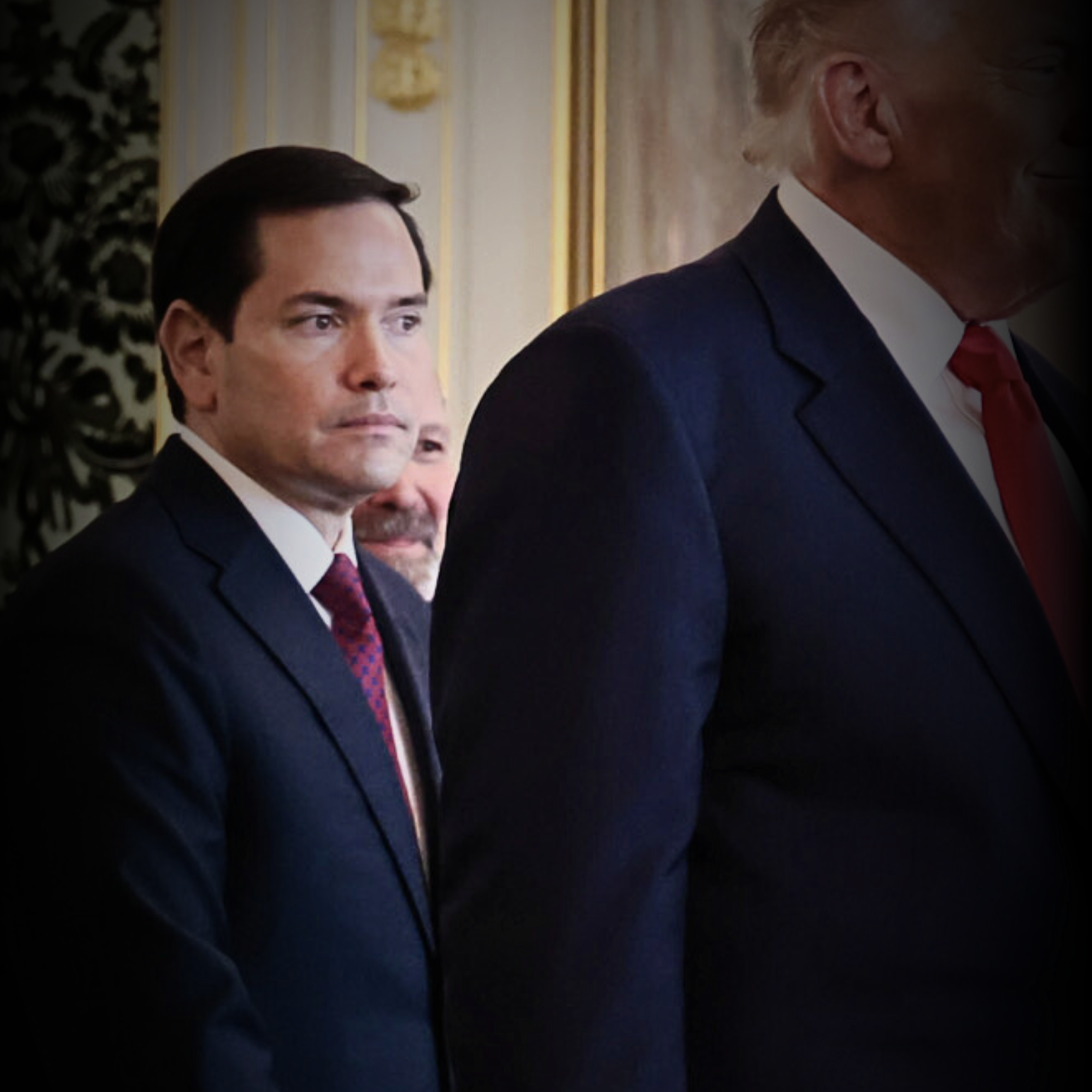
Marco Rubio and Donald Trump in Akasaka Palace in 2025. Photo by Cabinet Secretariat, via Wikimedia Commons (CC BY 4.0). Modified.
It is customary to express wonder and horror at the cynical baseness of the doctrine of Machiavelli. Both the wonder and the horror are justified—though it would perhaps be wiser to keep them for the society which the Italian described rather than for the describer himself—but it is somewhat astonishing that there should be so little insistence upon the fact that Machiavelli rests his whole system upon his contemptuous belief in the folly and low civic morality of the multitude.
- Teddy Roosevelt*
Teaching Machiavelli’s The Prince to undergraduates can be rewarding, but it can also be demoralizing. Zealous nineteen-year-olds sometimes like it a little too much. Read in its best light, The Prince can serve—probably against the author’s intentions—like a Screwtape Letters for political philosophy. If you want a principality, especially a new principality, Machiavelli illustrates, this is how you must behave to succeed, and that means behaving like a thug. If you want to rule morally, then a principality is not for you.
By contrast, the benefit of a republic (when it is functioning properly) is that it makes it possible for good men and women to succeed in politics. That is, in fact, a mark of healthy politics. Admittedly, no arrangement can prevent mediocre or even bad people from succeeding alongside good ones. Yet, this possibility for decent people to climb the ranks was not always there. Thug rule has been the norm throughout history. In most cases, the chances of good people succeeding in politics were about the same as they were in the mafia. Healthy republics are an exception, especially those highly developed republics where corruption has been contained, where democratic representation, the separations of power, checks and balances, and a relatively educated (and moral) public have created some space for ethically constrained rule.
It is the fact that we have grown up in such a political community that makes us shocked by our recent predicament, especially in the Republican Party. One by one, the most conscientious of our Republican politicians, people like Mitt Romney and Ben Sasse, have been compelled to leave or have chosen to bow out. It has become increasingly difficult for Republicans to survive political primaries, or be selected in the president’s administration, without damage to their integrity. When one is required to affirm the whims of a single man, when one is expected to tolerate or even affirm lies, for example, that the 2020 election was stolen, prudent and honest men and women are filtered out. This is most obvious in Trump’s Cabinet, where talent and intellect are usually only possible in proportion to moral deficiency. I say usually, because that ratio is challenged by the presence of one man: one who is certainly not without fault, but who cannot be said to be as immoral as he is competent. That man is Marco Rubio.
Rubio’s Unique Place in Trump’s Cabinet
There is no doubt that Marco Rubio is the most competent person in the Cabinet, and there is little doubt that he is the most conscientious as well. But his presence in the administration creates something of a moral dilemma for Rubio, if not a moral tragedy. If he leaves, he will surely be replaced by someone less competent and less scrupulous. If he stays, he will be asked to do things and support things that are in tension (to say the least) with his core commitments. Realistically, he will not come out of this unscathed. But he also can continue to be a positive force within the administration, not unlike those veteran conservatives who occupied Trump’s first administration and constrained the president’s worst impulses (e.g., Pence, Pompeo, Haley). Rubio’s effort to operate under these conditions have revealed both his immense political talent and the moral degradation that comes with such a task.
Take, for instance, Rubio’s recent celebrated speech at the Munich Security Conference. There is plenty to nitpick about the speech. He employs populist platitudes and myths that one frequently hears from people like J.D. Vance. But to his credit, he manages to employ the platitude, and then subtly take it in the direction of something more reasonable, more attractive to his audience. By doing so, it is almost as if he is trying to convince Trump’s base—and Trump’s administration—by giving their slogans a more restricted, reasonable meaning: by acknowledging the legitimate concerns of populists and persuading others to take those concerns seriously, he subtly neutralizes what is wrong in their position.
It has become increasingly difficult for Republicans to survive political primaries, or be selected in the president’s administration, without damage to their integrity.
For example, in that address Rubio employs populist rhetoric about free trade. We have all heard such claims: that our communities have been gutted by it, we’ve become less prosperous, we’ve become dependent on other nations. That is all an exaggeration. The truth is that we are richer now, even if some towns and regions are not. We are not more dependent on adversaries overall, but we have the independence that comes with many trading partners. Yet, that is how Rubio talked about it.
But in addressing Europe, Rubio subtly shifted the meaning of the “we” of the USA to that of the “we” of the USA and our allies: we, the USA and Europe, need to rebuild our manufacturing and become less dependent on adversaries. Given Trump’s actual trade policy, that represents a case of wish casting, but it can also be a way of persuading the side he is supposed to be defending—a tactic made more effective when that new position is popular with his immediate audience.
Similarly, Rubio regurgitated a talking point of J.D. Vance about how people will not die for “abstractions” but only for their people. This was an embarrassing moment for Rubio. And yet, even that slogan has some truth. A people and its culture matters. If you allow too many people to immigrate too quickly, a nation can feel like it is losing its culture and in extreme cases, even its values. Those who apply the notion to include race and ethnicity, however, have no place in the American ethos, and surely this was not Rubio’s intention. Even through that lens, however, the slogan is problematic because people do die for “abstractions,” and rightly so. Abraham Lincoln believed that it was up to the Union to preserve the Republican experiment of a nation governed “of the people, by the people, for the people.” Taken literally, this populist slogan is not only wrong, but un-American. And yet, it was getting at some truth in the context of critiquing Europe’s bureaucratic sloganeering and its unrestrained immigration.
Though handed a near impossible task—to please both Trump’s base and his European audience—Rubio succeeded. He employed some populist slogans while presenting an overall vision of partnership between the United States and Europe that satisfied everybody. His audience even gave him a standing ovation after he closed with a beautiful narrative about the United States and Europe, about their common history, their common goals, and how America would never abandon its older sibling. Again, he was persuading Trump and his base just as much as he was trying to persuade Europe. Were we better off after the speech than before? I would argue yes. The hope of reconciliation between the two sides increased after Rubio finished, because he managed to inspire both sides and to soothe tensions. Notwithstanding those parts I criticized above, it was one of the most impressive works of political rhetoric we have seen in years, and showcased Rubio’s unique talent as a politician.
One can sense a similar tactic in Rubio’s approach to Venezuela. The way Trump talks about the Maduro raid and our policy in Venezuela is almost exclusively transactional, focused on oil and how it will lower our gas prices. But Rubio, when questioned about it, has responded with a sensible and noble plan for transitioning Venezuela back to democracy—something that was stolen from it by Maduro, who, according to international consensus, stole the last two elections. And there is little reason to doubt Rubio’s intention here. If there is one constant in this Cuban American politician’s career, it is a desire to lift the boot from Latin Americans, like those in Cuba and Venezuela. There is a reason he is so popular among those communities. Whether Trump lets Rubio carry out this transition, or instead makes it about his transactional interests, is an open question. And Congress should work to ensure Venezuelans are not abandoned. But if Rubio’s efforts within the administration succeed, that could do a lot of good not only in Venezuela and the rest of Latin America, but also here in the United States.
But we cannot talk about Rubio’s place in this administration without mentioning the flip side: the humiliation and moral degradation that comes with being Trump’s deputy. We saw this almost immediately after Rubio’s celebrated speech in Munich; Rubio traveled to Hungary where he served as Trump’s vassal to endorse the country’s prime minister, Viktor Orbán. Orbán is rightly controversial for the illiberal ways he tips the scale in favor of his ruling party in Hungary. He is also rightly criticized for his coziness with Vladimir Putin, and for his obstruction of Ukraine. Rubio surely knows this and has even criticized Orbán in the past. And yet, there he was, praising Orbán, expressing the president’s endorsement of him, promising financial support to Hungary so long as Orbán remained in power. It was not Rubio’s finest moment. Lucky for him, Trump’s endorsement has not seemed to help Orbán, at least if we take betting markets as a guide.
Regardless of whether Rubio has chosen the correct path, we can all agree he has chosen the more difficult path. Is Trump’s administration better off with Marco Rubio? Surely yes. Those who say no should consider how much better Trump’s first term was, when he had a cabinet of mostly competent veterans, not a clown car like now. And unlike Vance, who both embraces what is bad in Trump and influences Trump to become even worse, Rubio is typically the voice nudging Trump’s administration in a more reasonable direction.
If I were a utilitarian, it would be easy for me to say Rubio is right to stay. But I am not a utilitarian. Even when Rubio’s politicking is not inherently bad, it is morally dangerous. Some forms of deception, mental reservation, and equivocation do not constitute full-blown lies and are even morally justifiable in certain situations. But to put oneself in a position in which one must use these tactics daily is morally perilous. So while America is better off if Rubio stays on, despite what this asks of him, it is less clear that Rubio himself is better off. That he even faces this choice is why I call this a moral tragedy.
That is not to excuse Rubio for his faults. He is a grown man, responsible for his own behavior. It is to say that his decision and his situation are not easy. It behooves Trump to not put him in that position. It behooves the general and primary electorates to hold people like Trump accountable. And it behooves conscientious Americans to get involved, vote in primaries and general elections, and not allow things like this to happen.
James Madison is well known for saying that if we were all angels, we would not need government, and since we are neither angels nor governed by angels, we need a system in which “ambition must be made to counteract ambition” (Federalist 51). On this, he is right. Lesser known, however, is that Madison also insists, when speaking of those “qualities in human nature which justify a certain portion of esteem,” (i.e., virtue) that “republican government presupposes the existence of these qualities in a higher degree than any other form” (Federalist 55). Thus, even in a republic we run into the problem identified in the opening quotation from Theodore Roosevelt: we cannot enjoy the full benefits of republican government without an educated, moral people that is willing to hold politicians accountable. May we learn from these last years and make moral governance possible again.
Endnote
* Theodore Roosevelt, “Promise and Performance” in The Strenuous Life: Essays and Addresses (Dover Publications, 2009), 67–71, at 67. Originally published in the “Outlook” (July 28, 1900).