The Puritan Payoff
For the Puritans, literacy was not a luxury; it was an important part of their piety because only thereby could one read the Bible. This is evidenced by the fact that, after only six years in the howling wilderness of New England, when settlers were still struggling to survive and build their own houses, they founded a college: Harvard.

George Henry Boughton, Pilgrims Going to Church, oil on canvas, 1867 (Photo: Wikimedia Commons).
Despite Marxism’s failure, skepticism about the economic impact of religion remains stubbornly high. The ivory towers of modern academia often relegate spirituality to a mere footnote in the ledger of progress. Indeed, one University of Chicago economist dismissively suggested to me that theology was simply what Northerners did to fill their long winter nights. Though no Marxist, Nobel laureate Robert W. Fogel long viewed religion as an economic “opiate”—a negligible factor in his economic history.
But then, a paradigm shift occurred. His uncovering of the historical roots of abolition changed that perspective. Rather than debating abstractions, New England offers a tangible example of how religious ideas drive economic growth. To understand this shift, we must call upon the foundational work of Fogel’s mentor: Simon Kuznets (1901–1985).
The Dawn of Merchant Capitalism
When the Puritans arrived on the rocky shores of Massachusetts, they were planting their ideal “City upon a Hill” during what was still the morning of an economic epoch. Kuznets described these “economic epochs” as distinct periods characterized by an epochal innovation: an addition to the stock of human knowledge that provides a potential for sustained economic growth. Kuznets believed that the discovery of the New World was the basis for the epoch of merchant capitalism. This epoch stretched from the end of the fifteenth century all the way to the second half of the eighteenth century.
The opening of America made merchant capitalism possible; in turn, merchant capitalism challenged the existing social structure. These cascading changes contributed to the development of the modern economic epoch.
Enter the Puritans. Puritanism arose from the merchant class in particular and thrived in this dynamic environment. Puritanism also challenged the validity of many long-held assumptions. These were the sort of people who could overturn traditions for the sake of their vision, a “City Upon a Hill.” Because they were determined to apply their faith to the marketplace, the Puritans laid the “spiritual framework” that Kuznets believed was essential to the epochal innovation.
Science, Sanctity, and Survival
Kuznets found that new attitudes were necessary to facilitate the adaptation of social institutions and practices to the new potential offered by science-based technology. Western culture needed a force capable of shaping people’s worldview so that they could adopt innovations. The Puritans provided these attitudes. The fact that such ideas came armed with religious sanction gave them potency. Puritan ministers, like the famous Increase and Cotton Mather, were dedicated scientists because of their Puritanism.
Controlling nature—from droughts to epidemics—fostered a belief that humans could master their destiny or “at least [could] be relatively free from unknown and uncontrollable terrors.”[1] Today, we associate this movement toward control over nature with science, but we, in turn, inaccurately associate science with secularization. Yet the Puritans encouraged ways to gain control over their world because of their conviction that God was the Creator. Since nature could be God’s means of working, mastering it could yield more of His kingdom on earth. Cotton Mather’s pioneering use of inoculations against smallpox, which he championed against the hysterical warnings of local doctors, is an example of this. See “When Puritan Theology Helped Develop Immunology.”
The Literacy Leap
Education is another layer of bedrock for the modern economy that the Puritans helped lay. Kuznets insisted that the spread of education was key to increasing the capacity of nations to contribute to the stock of practical knowledge. For the Puritans, literacy was not a luxury; it was an important part of their piety because only thereby could one read the Bible.
This is evidenced by the fact that, after only six years in the howling wilderness of New England, when settlers were still struggling to survive and build their own houses, they founded a college: Harvard. The Puritan ideal of the minister was fundamentally that of a teacher. The pastor’s main role was not simply to officiate ceremonies, but to deliver meaty messages full of information and exhortation.
In New England, literacy was widespread. Kenneth Lockridge conservatively estimates that by 1660, about 80 percent of men, including those living in rural areas, had at least basic reading ability, compared to less than 50 percent in England (for rural people) at the same time. Full literacy, including writing ability, had risen to 85 percent by 1750. Since full male and high female literacy spread rapidly even in rural areas, it appears that it was Puritanism, not capitalism as in England, providing the impetus. Lockridge found that New England was a Puritan society that achieved its goal of universal male literacy, thus having a transformative long-term effect on the economy.
Divine Intentions and the Family Ethic
Some modern scholars attempt to strip the Puritans of their religious motivations. John F. Martin, in Profits in the Wilderness (1991), tries to argue that because he can document cases in which Puritans established land companies before they planted churches, they were able to compartmentalize reality and separate their secular goals from—or elevate them above—their religious zeal. This analysis cynically assumes that the mere order of events reveals a person’s priorities. If a student came to Chicagoland to get a graduate degree, and yet the first activity he engaged in was procuring housing, by this logic, we would have to conclude that finding a place to live was his real goal in coming to Chicago.
Besides reading too much into chronology, Martin wrongly concludes that the Puritans must have had an instinct for compartmentalization. He assumes this is the only way they could have dealt with the so-called contradictory commands of having diligence in worldly business but deadness to the world. He also sees contradictions in regarding a town as a business venture one moment, a community the next, and a religious refuge the next. But it is because the Puritans did not regard business, community, or church to be in any necessary conflict that they acted on all these visions of New England at once. Far from being neatly compartmentalized, their worldview was integrated around an overriding quest for the glory of God. For example, when the Atherton Company planned to establish a new town, it made provision in the planning stage for the maintenance of an able, godly, orthodox minister.
Besides their famous work ethic, the Puritan family ethic also prepared them for economic survival in New England. In part because the Puritans were denied the opportunity for a root-and-branch reform of the Anglican Church back home, they focused their energies on the godly family. According to Ian Breward, the family was to be an agent in moral and religious reformation that would ultimately win the nation to the right service of God.
Central to this domestic order was the passing down of Puritanism through family religion. The family was seen as the instrument for preserving and transferring what Robert W. Fogel termed “spiritual resources.” These resources included the work ethic, benevolence as a virtue, a hope for opportunity, and a love of learning. Puritanism taught the necessity of transferring these spiritual resources to the next generation through what they called family worship. Every father was expected to be a pastor to his own children, and every day he was to lead his family in prayer and Bible study. This emphasis Puritans placed on the family proved essential for their economic survival and their ultimate success in the New England colonies.
The Demographics of Destiny
The demographic makeup of the early colonies tells a story. Unlike Virginia, which the Puritans referred to as a “Plantation of Trade,” colonists flocking to New England were more age diverse. From the beginning, New England was colonized by a large number of families, which stands in contrast to the high proportion of single men who came to Virginia.
Lists of three English ships bound for America in 1635—two sailing to Virginia and one destined for New England—demonstrate Puritanism’s impact on immigration to these two distinct colonies. The Virginia-bound ships featured a lopsided male-to-female ratio of 4.18:1, while the New England-bound ship was remarkably near parity at 1.32:1.
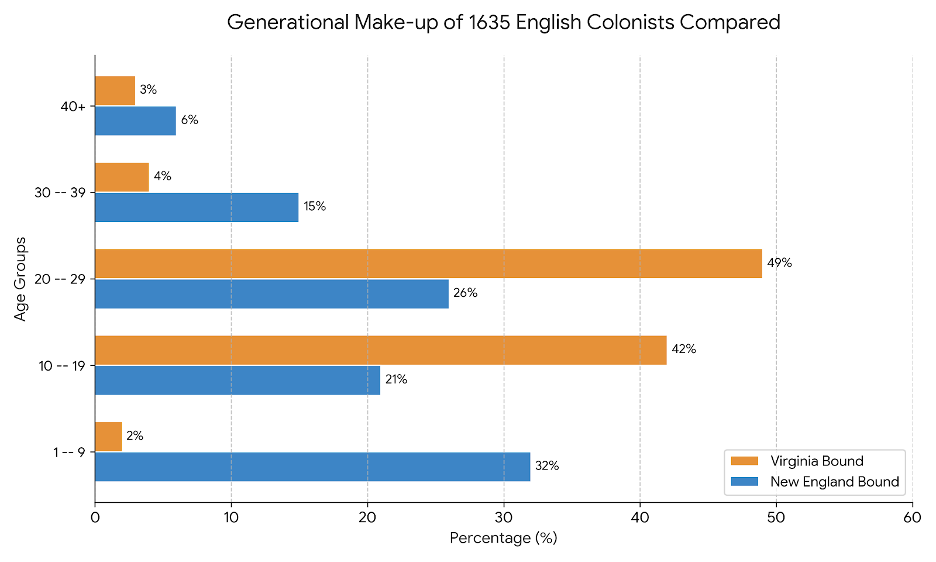
Comparing the age differentials of the two groups of colonists also highlights the predominance of families in New England. The Virginia-bound colonists were largely in their prime working ages; an overwhelming 89.5 percent were between 16 and 32, while a mere 4 percent were over 40 years old. There was only one child in the two Virginia-bound ships, indicating a nearly complete absence of families heading to the Plantation of Trade. In stark contrast, the Puritan family ethic drew a more age-diverse group of colonists to New England. Only 32 percent of them were in that prime working age range of 16 to 32. This pattern suggests that they were going to New England for reasons other than primarily economic ones.
Furthermore, when the Massachusetts General Court asked the local churches in 1639 to scale back the number of weekday lectures so people could have more time to work, the ministers indignantly replied, “Liberty for the ordinances was the main end of our coming hither.”[2] There is emphatic literary evidence from the founders of New England and their children—especially their children—that the society they were going to start was intended as a plantation of religion. If profit were the only goal, why choose rocky New England over the lucrative opportunities in the Chesapeake or West Indies?
If the true motivation was not religious, then why did migration to New England suddenly halt, even reverse, when the explosive Puritan-Parliament uprising finally began back in England? Total migration from England to the other colonies, after all, continued unabated during the chaotic 1640s. Puritans at the time were asking themselves, why travel an agonizing 3,000 miles to create a new society when one could now remake the world at home?
The Population Bomb
This religiously motivated immigration pattern had economically beneficial effects for New England. Because of the scarcity of labor, unlike in old England, New England landowners needed their children to stay with them for as long as they could to contribute to the family farm. As there was untamed country to be cleared, farms and fences to be built, and hungry mouths of numerous younger children to be fed, the relatively inexpensive labor of offspring was essential to family welfare. The advantages of family and community in this harsh world were enormous. The presence of women improved family nutrition, leading to lower mortality rates. New England possessed low mortality rates and high birth rates throughout the colonial period. In Europe, only about half of all children ever reached childbearing age. But in places like Andover and Plymouth, Massachusetts, during the seventeenth century, 90 percent of children survived to be parents themselves.
Because of the robust Puritan family ethic, Puritan settlers were able to hit the ground running upon arrival, with intact families there to support them. Intact families gave Puritan New England two advantages. The prevalence of women meant that the back-breaking weight of household chores needed to keep a seventeenth-century frontier farmer alive could be efficiently borne by wives and children, while the husband devoted his primary energies to the farm. Secondly, the invaluable habits of domesticity, including the passing down of religious values, could be seamlessly carried on.
The New England family ultimately made possible what was destined to be one of Puritanism’s most cultural weapons: a population bomb. Although mass immigration to New England fell off precipitously after the calling of the Long Parliament in Britain, the population in New England remained high. In direct contrast to the other colonial regions, New England actually experienced a net out-migration. And yet, of the four distinct regions of British North America—New England, Middle, Upper South, and Lower South—New England boasted the largest free white population.
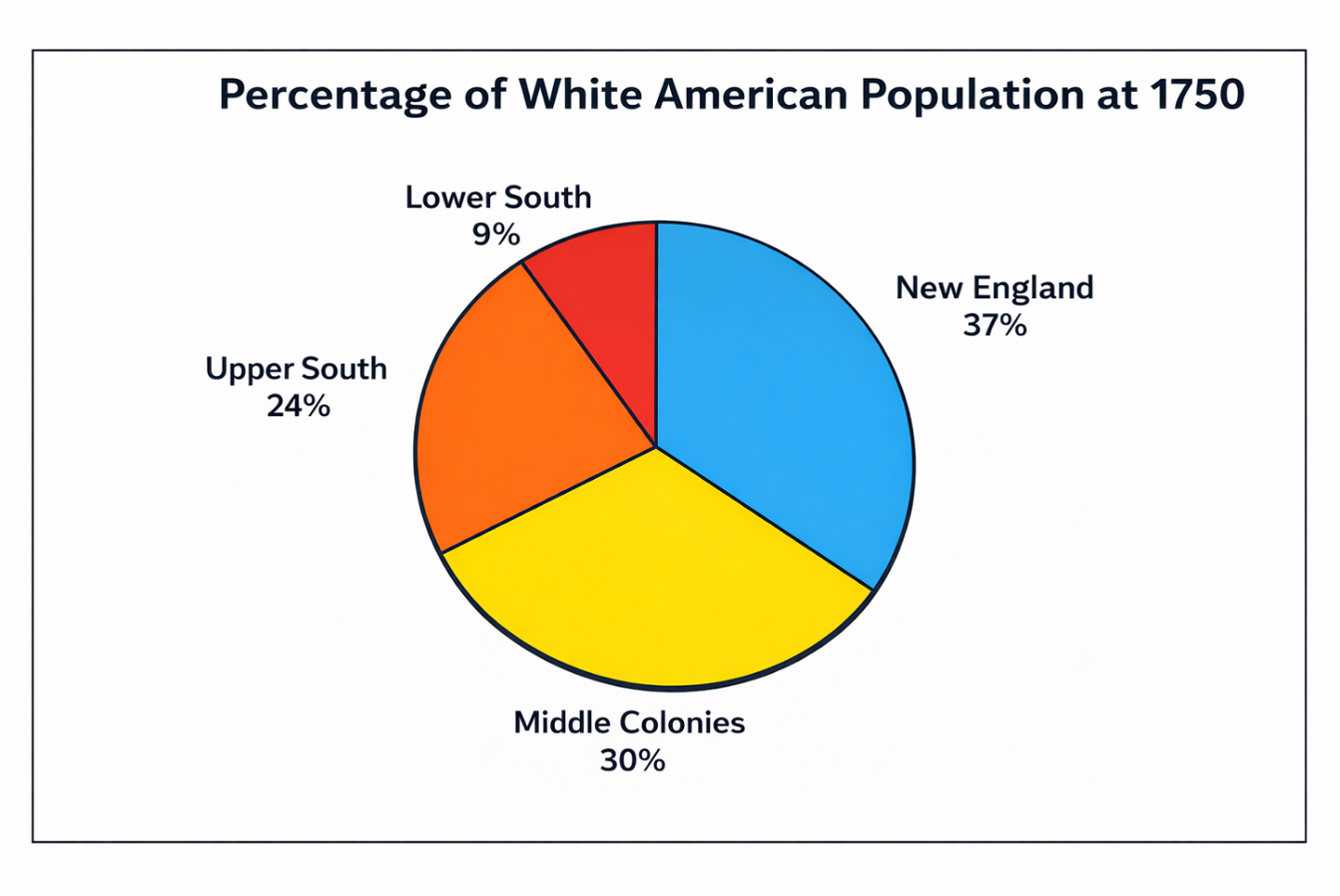
This demographic dominance was a direct fruit of New England’s fruitful families, itself a fruit of its faith. In other words, New England enjoyed enough natural population growth to compensate for a net out-migration and still outpace the other regions. This population explosion, based entirely on the original hardy Puritan stock, set in motion the “Yankee Diaspora.” Nobel Laureate Robert W. Fogel, in The Fourth Great Awakening, calculates that by 1820, 80 percent of the population living north of the 40th parallel (just above the “Mason-Dixon line”) was culturally “Yankee.” This wasn’t just a migration of people; it was the migration of a worldview. From the rocky coasts of Massachusetts to the fertile plains of the Old Northwest, the Puritan ethos of disciplined labor and universal education became the de facto cultural code for the rising American industrial heartland.
Social Capital and the Invisible Economy
The other vital institution of early social capital was the town itself. The town, bustling with its meetings and face-to-face immediacy, served as the community level slightly above the family but closer and more personal than the commonwealth and the distant empire.
The town kept early New England socially cohesive, and the colonial governments’ requirement that new towns only be settled with their official permission kept the settlement of New England orderly. Scholars T. H. Breen and Stephen Foster note how exactly these core institutions gave New England internal stability in an unstable age when Europe itself was frequently convulsed with strife.
This social capital lowered transaction costs. Making their rigorous ethical standards a living part of the local culture, Puritans, at least in theory, lowered transaction costs, including the costs of enforcing property rights. Since we have seen that Puritan faith shaped their immigration patterns, there is no reason to suppose that it would not also affect individual business ethics, especially since such high ethics were a part of Puritan religion itself.
This trust bore financial fruit.
The burgeoning shipbuilding industry demonstrated the decisive role of early Puritan institutions and social capital in the economic development of early New England.
Shipbuilding first tapped what historian William N. Parker (1919–2000) believed were the prerequisites for an industrial revolution.
These prerequisites included a skilled and motivated population, stable families, literate and competent craftsmen, spirited entrepreneurs, and the practical behavior of merchants, farmers, workers, wives, and businessmen.
Each one of Parker’s identified prerequisites for the coming Industrial Revolution was influenced, if not created, by the force of Puritanism.
From Rocky Soil to Economic Metropolis
How did Puritan faith impact economic performance in the unforgiving New England of the seventeenth century? By making it possible.
New England had proved its inhospitality by foiling several prior attempts to plant a colony there. The land possessed a hard, thin, rock-filled soil. One explorer, Christopher Levett (1586–1630) remarked that the land was “good for nothing but to starve so many people as comes in it.”[3] It offered a punishingly short growing season, bone-chillingly cold winters, and no real prospect of ever discovering either precious glittering metals or a lucrative, fast-growing cash crop. New England had a hard time growing economically because initial geographic expansion for any colony is a function of external demand. There was little demand for what cold New England could produce.
But instead of whining, the Puritan John White (1575–1648) insisted that New England offered the kind of environment that the sacred plantation of religion needed.
If men desire to have a people degenerate speedily, and to corrupt their minds and bodies too, and besides to [draw in] thieves and spoilers from abroad; let them seek a rich soil, that brings in much with little labour; but if they desire that piety and godliness should prosper, accompanied with sobriety, justice and love, let them choose a country such as this is; even like France or England, which may yield sufficiently with hard labour and industry. The truth is, there is more cause to fear wealth than poverty in that soil.[4]
Hence, rocky New England was perfect for the hardy Puritans. Offering few easily obtainable commodities, the land required that the colonists either labor arduously or perish.
Despite their environment, within a single generation, New Englanders were becoming “the Dutch of England’s empire.” These New Englanders, long since known for their Yankee ingenuity, were able to develop nonagricultural services, like shipbuilding. They innovated in extractive industries related specifically to the sea and the massive forests, but they also dominated in key manufacturing and commercial activities.

The result? By 1840, rugged New England, along with bustling New York, New Jersey, and Pennsylvania, boasted a per capita income nearly twice that of the South. The Puritans’ spiritual ethic built the structural foundations that allowed a harsh land to not only be settled, but to flourish.
Endnotes
[1] Simon Kuznets, Modern Economic Growth: Rate, Structure, and Spread (Yale University Press, 1966), 62.
[2] Winthrop’s Journal, I, 326; according to David Hall, The Faithful Shepherd, 125.
[3] Bernard Bailyn, The New England Merchants of the Seventeenth Century, 6.
[4] John White, The Planters Plea (William Jones, 1630), 391.