Wicked Bad: The Dangers of Rhetorical Inflation
Being forgotten as interlocutors by our neighbors is the ultimate danger of the trend toward rhetorical inflation. When every social issue is framed in the most damning or superlative way, we lose the ability to communicate with one another. The data suggests we are already long past this point. Every day, the social fabric frays a little further while the few moderating forces that exist futilely attempt to keep the whole thing from unraveling.
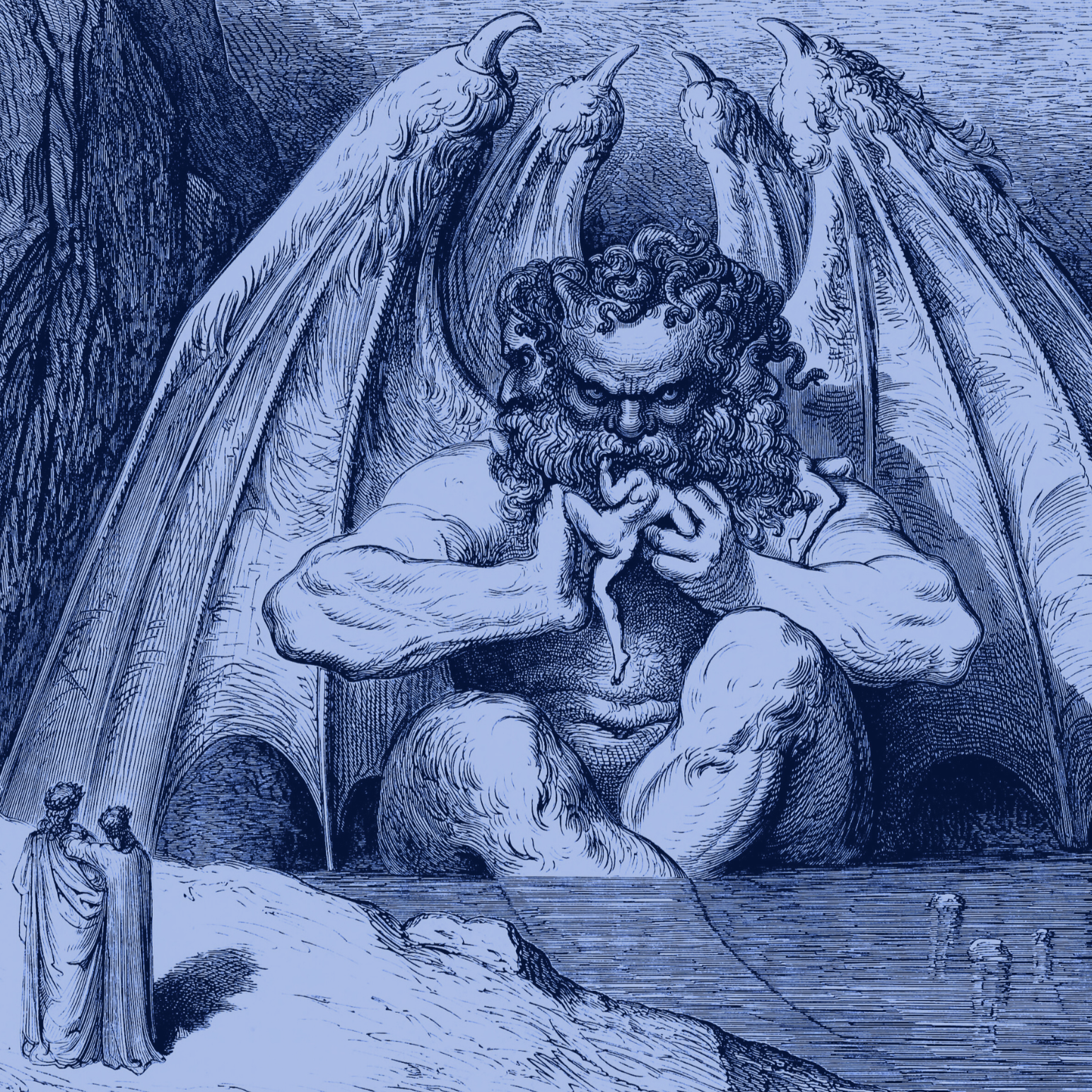
Engraving by Gustav Doré depicting Dante’s Lucifer. 1861. Photo: Wikimedia Commons.
A recent headline on churchleaders.com reported that well-known Reformed evangelical preacher John Piper had declared the use of AI to prepare sermons to be “wicked.” Piper chose the word wicked to describe the moral status of LLM-assisted sermon preparation from a long list of possible alternatives. He could have said such a practice was wrong, dishonest, troubling, or even problematic. Tarnishing and improper would have worked too. Instead, he chose, from among all these alternatives, to employ the adjective wicked.
Consider what this means. Merriam-Webster defines wicked as “morally very bad, evil.” In other words, Piper here has declared the use of AI technology to aid in sermon prep “evil” or “as bad a thing as can be.” It’s hard to see where we go beyond wicked. How do we describe something that is even more morally bad than AI-assisted sermon prep when we have already employed the strongest possible language?
What adjective do we apply to the sexual exploitation of children, to politically motivated torture, to genocide? If we want to condemn the moral status of a thing and we have already used wicked and evil, we are kind of out of rhetorical ammo at that point. Our language simply does not offer an alternative for something more wicked and evil than the words wicked and evil have already captured.
And here arises the trouble. Murder is wicked. The abuse of children is wicked. Genocide is wicked. The heartless exploitation of the weak and vulnerable all over the globe wherever it occurs is wicked. Now, we must add to this list of wicked things, according to John Piper, the use of artificial intelligence to help prepare sermons. The absurdity is undeniable.
Through constant engagement in acts of rhetorical inflation, we drive up the cost of trying to say things well, of understanding those we disagree with, and of maintaining a civil society.
Whenever we apply the most powerful and extreme words available to a phenomenon that does not warrant them, we have made a mistake. We have engaged in an act of rhetorical inflation that, by overstating the moral status of an action, renders us helpless to credibly describe events and patterns that do, indeed, warrant the most extreme praise or condemnation our language can render. Through constant engagement in acts of rhetorical inflation, we drive up the cost of trying to say things well, of understanding those we disagree with, and of maintaining a civil society.
And, not to exaggerate the problem, this kind of rhetorical inflation is everywhere today. Piper, as one might imagine, is on the right, and he is not the only one on that side to indulge. Conservative commentators offer more than a few examples. Take Matt Walsh, for example: on a single day, a perusal of his X/Twitter feed reveals his description of a purportedly unattractive liberal woman as looking “like […] the Joker escaped Arkham” and “went trans,” his claim that “everything you were taught about slavery is a lie,” and that “no successful person in the history of the world has ever found the keys to their success in a self-help book.” All of these statements exaggerate for rhetorical effect. All raise the temperature of civil debate, and all are examples of the kind of rhetorical inflation that is making debate impossible in our time.
The same problem exists on the Left. Trump is literally Hitler. Anyone with a bit of political memory can remember when George W. Bush was also Hitler. Let’s not forget his father was Hitler too. I am old enough to remember when even the now much-vaunted Ronald Reagan was, you guessed it, Hitler. The Left has produced quite a bit of non-Hitler-related rhetorical inflation as well. A couple of examples will suffice. In 2019, Alexandria Ocasio-Cortez claimed Trump was running concentration camps. During the 2024 election, Kamala Harris repeatedly called Donald Trump “a fascist” and “a threat to our democracy and fundamental freedoms.”
While some of the examples may be more egregious than others, they all make the point that our culture, especially our political life, is dominated by people with no rhetorical self-control. In fact, we find ourselves repeatedly at the mercy of people who would be ashamed to practice such self-control because of what such level-headed restraint would say about them.
The practice of rhetorical inflation is impossible to understand without some reflection on its causes and functions, which are many. Let’s consider three: one psychological, one sociological, and one technological.
First, rhetorical inflation makes you elite. That is its appeal. By denouncing as “wicked” what everyone else only considers merely troubling, you convince yourself you are particularly morally sensitive. If all your peers think Trump is a bully, but you alone can see that he is actually Hitlerian, what does this say about you except that your eye for political reality is keener than that of the muddled fools who surround you?
Rhetorical inflation does not only give the practitioner a sense of superiority. It also reinforces his importance in the tribe. Everyone loves to see how far he will run into the wilderness of hyperbole, how cavalierly he will abandon propriety and even reason in pursuit of the rhetorical excess that establishes a platform upon which he may stand to be admired. That is how tribes work. Whoever hates the enemy the most becomes a hero.
And thus do we arrive at the phenomenon’s sociological function. Rhetorical inflation serves to distinguish the true from the tepid within the group. Those most given to rhetorical extremes are assumed to be those most committed to the cause. To exaggerate lifts an individual to the tribe’s social summit. If, for example, you are the one screaming loudest that the Left wants to destroy America, it makes sense that you would be assumed to be the one most committed to not letting that happen. Thus does one’s elite status in the tribe come to mirror the inner sense of superiority the habit has cultivated in the speaker. So when he is finally raised above his peers in praise of his fire and conviction, the applause seems only right to him.
These psychological and social temptations alone could never have brought us this close to a fraying society if everyone had not had at his disposal the means to disseminate his most extreme takes. The advent of social media removed a safeguard we did not even know we had. What few realize, and perhaps even fewer say, is that social media is a colosseum and the game inside is competition for attention and popularity.
When the psychological need for affirmation and the social desire for status meet a never-ending competition for attention, things deteriorate. People no longer filter the world even partly through the question, “Is this true?” They filter it almost exclusively through the question, “Will this get a reaction?”
The quest for reaction naturally leads to being as outrageous and as provocative as possible, which is to say it leads naturally to rhetorical inflation. As the social media environment has displaced the real-life social environment, rhetorical inflation has become the common tongue to such a degree that moderation becomes difficult for many people to understand. We who advocate restraint are now speaking a language forgotten by our neighbors.
And being forgotten as interlocutors by our neighbors is the ultimate danger of the trend toward rhetorical inflation. When every social issue is framed in the most damning or superlative way, we lose the ability to communicate with one another. The data suggests we are already long past this point. Every day, the social fabric frays a little further while the few moderating forces that exist futilely attempt to keep the whole thing from unraveling.
The trouble with problems of social discohesion is that they cannot be solved at the social level. Such problems undermine the very basis for the social action necessary to resolve them. The problem of rhetorical inflation is one of these because it undermines the possibility of reasonable discussion and compromise. If anything is to be done to improve the situation, it must be done at the level of the individual.
Each of us must watch what we say. Only by individual effort to moderate our speech will a norm of restraint be reestablished. While we cannot, individually, mandate that more nuanced, careful language be used on the internet, we can decide how we will speak in our homes. We can set the example there. We cannot change the dialogue on social media, but we can change how we post.
There will be costs. True believers will think we are going soft. They will accuse us of sympathizing with the enemy. If we have worked hard to ascend the status ladder in our group, we should prepare for a long, maybe bumpy, downward slide. Prepare to be unpopular with both friends and algorithms. The latter will punish you. Your content will go unnoticed, unliked.
The costs, however, will be worth it. Even if you make no big impact on the wider culture, you will know you did not inflame that problem. The world will not heed your charges, but your world will. You will flow against the troubled current of our time. Accept modest gains. See both sides. Think in complex trade-offs. Let even your worst enemy be human. You will have to give up hope for a total victory and accept the terms of a reasonable surrender. And, in that, lead the way.