The Next Age of American Capitalism
Capitalism doesn’t cause inequality; greed and passivity do. Capitalism gives people the freedom to build markets that reflect the times.
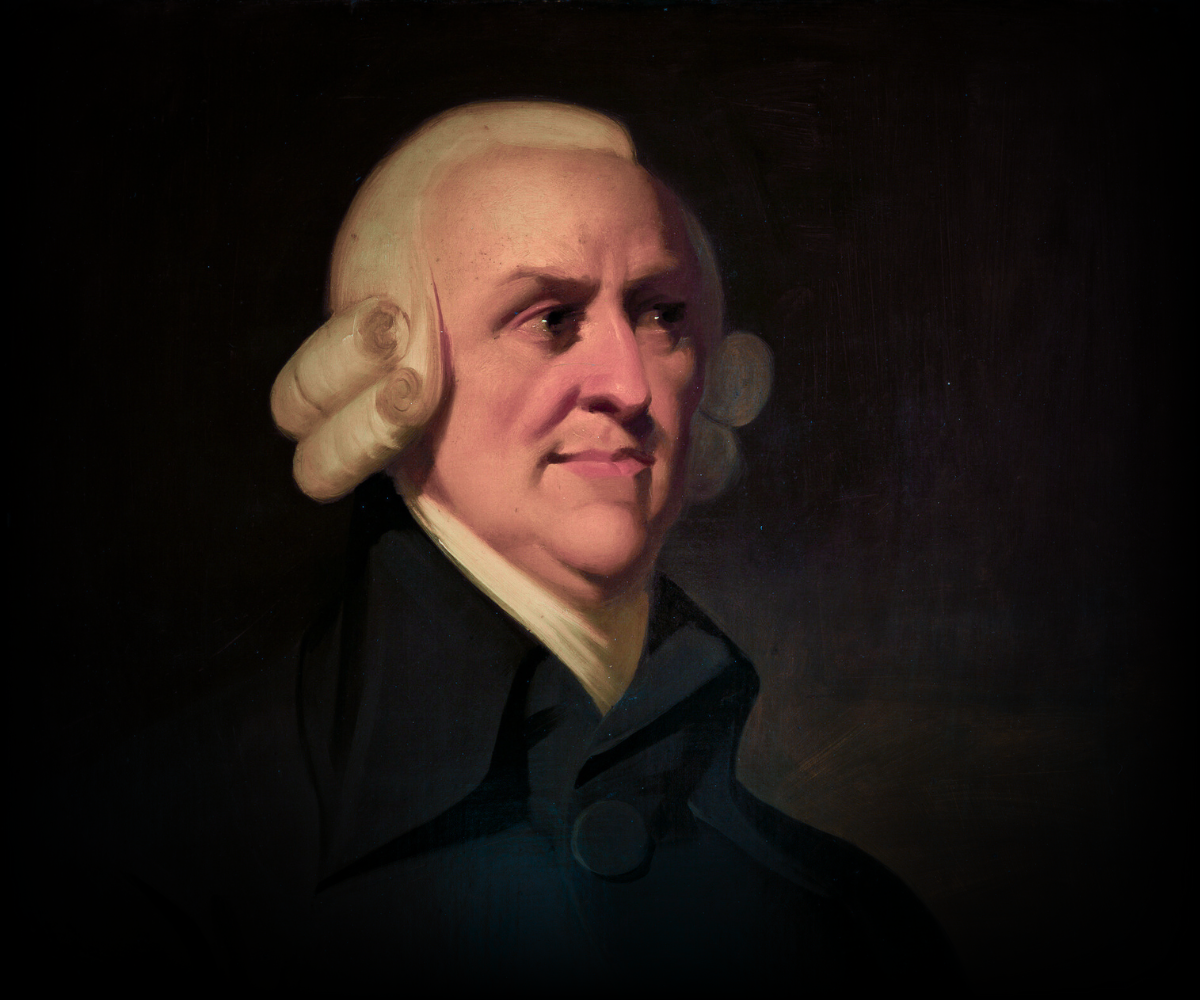
Adam Smith, artist unknown. Photo: Wikimedia Commons.
Currently the economy is stagnating, inflation is rising, and opportunities are limited. As a result, capitalism is under attack. In New York—the financial capital of the world—a new mayor, Zohran Mamdani, was just sworn in, despite questioning whether we should even have capitalists, saying, “I don’t think that we should have billionaires.” But capitalism is widely misunderstood, and the angst people feel against it is just a reflection of the moment.
What if, instead of having fewer capitalists, we had more?
Adam Smith is often credited as founding capitalism through his book The Wealth of Nations. He did not, however, present a rigid economic system but instead offered an observation on how people behave within commercial society. Smith argued that markets function best when supported by moral norms and social trust, ideas he presented in The Theory of Moral Sentiments.
In The Wealth of Nations, Smith used the example of a pin factory to show how division of labor and specialization increase productivity. With individuals focusing on specific tasks, output expands beyond what isolated labor could achieve. Productivity driven by self-interest that operates within social and legal constraints enlarges markets and encourages further specialization.
“Instead of controlling chaos or extracting wealth and redistributing it, we could choose to invest in ourselves. The Age of Stewardship would replace subscription dependency with ownership.“
Instead of viewing economic life as competition over fixed resources, Smith saw commercial society as human potential that increases the value of resources through refinement, coordination, and exchange. The market becomes a place of both competition and cooperation, where the individual pursuit of gain, checked by institutions and moral norms—vice checked by virtue—promotes broader prosperity.
Jonathan Levy explains in his book, Ages of American Capitalism, that capitalism is not a single thing; it has taken many forms throughout American history. Capitalism works best when the system incentivizes owners of capital to invest in labor, encouraging commerce through a division of labor that makes production more efficient. As markets grow, the “Smithian multiplier” kicks in, expanding trade and profits and pushing capital to invest rather than hoard.
James Carville famously said, “It’s the economy, stupid.” He is largely right; most Americans, or people in general, are willing to overlook a lot if the economy is humming. Wages go up, so people have extra money to spend. People are employed, so they are focused and have purpose. Production and consumption rise in union, capital, and labor profit.
During times of prosperity, corruption can be at its highest. The Gilded Age was marked by the Crédit Mobilier scandal, robber barons, and the spoils system of party politics. The roaring twenties saw the Teapot Dome scandal, legalized insider trading, and over-speculation that led to the stock market crash of 1929. Yet, I bet that if you asked most Americans during that time of corruption whether they approved of the politics, they might have complained but still have supported the politicians in charge. Most are happy with the status quo when everybody is profiting; however, when times are tough, voters take a second look. When they get involved, what follows is reflection, regulation, and reform.
Adding a little order, building a fence or two, keeps the wolves out and allows the cows to keep grazing. Sometimes the system expands; sometimes it contracts. The opportunity shifts from those who have corrupted the system to a new group of people—people who are tired of the status quo and ready to invest in new ideas. As investment spreads, the market expands to meet demand, and prosperity follows.
Politicians, capitalists, and laborers are all to blame when the system stagnates. Instead of pointing fingers, we should look forward. Each age of capitalism involves stagnation, but the beauty of capitalism in a free government is that it allows for a reset—a fresh start in a future that is unlimited and always worth betting on.
In American history, Levy explains, the capitalist system has adapted in response to the people who run it. During the Age of Commerce (1660–1860), risk was managed through a system of trade networks with merchants built on reputation through contracts, emphasizing market expansion and commercial exchange. From 1860 to 1932, the Age of Capital gave rise to capital accumulation, corporate organization, and a cycle of boom and bust. The boom-and-bust cycles brought about the Age of Control from 1932 to 1980, which managed risk through state and corporate bureaucracies. This period saw the rise of insurance, regulation, and Keynesian economics. Employment was stable, the welfare state was built, and stability replaced volatility. The Age of Control was followed by the Age of Chaos (1980–present). Deregulation pushed risk back onto individuals, leading to financialization and creating asset bubbles and market volatility. Meanwhile, globalized capital weakened labor institutions.
At the end of each period, capital invested more in itself than in the broader population, thereby concentrating economic and political power. The system of slave labor of the Age of Commerce failed to integrate the larger population. The Age of Capital led to a small group of capitalists gaming the system until confidence crashed in 1929. The Age of Control ushered in a crisis of capital, in which excessive control strangled innovation and investment. This led to stagflation, rising labor costs, and declining industrial productivity. French economist Thomas Piketty explains that this kind of stagnation occurs when capital returns exceed wages, and wealth is pulled out of the economy rather than reinvested in productivity. The circulation of wealth dries up, confidence weakens, and the market stagnates.
Here we sit at the end of the Age of Chaos. The beginning of the Age expanded markets and opportunities, but today we face a concentration of power that has shifted us into a subscription economy. A strong capitalist economy is supported by broad ownership and investment in labor. Our subscription economy, however, trades ownership for access. We used to buy CDs and DVDs, but now we rent them. We used to build businesses, but now we pay platforms for access to customers. The subscription economy prioritizes rising fixed costs and endless payments, with little to no equity accumulation. With little incentive to invest in labor, spreading wealth to a larger portion of the population, income continuously flows upward.
Right now, unlike Smith’s vision of a virtuous marketplace, vice industries are unusually well-adapted to the subscription economy, so they grow faster than many productive ones. The end of the Age of Chaos has seen growth in online gambling and sports betting, porn platforms and cam economies, speculative trading assets like bitcoin, along with pacifying industries such as legal and illegal drugs. They are popular and profitable because they offer high emotional rewards, encourage repeat consumption, and have a low cost of entry.
The reason many people dislike capitalism right now is that it’s not working for them. At the end of his book, Jonathan Levy challenges us to decide what version of capitalism comes next. I see three future possibilities: The Age of Techno-feudalism, The Age of Control 2.0, or The Age of Stewardship.
In an Age of Techno-feudalism, tech companies would monopolize market platforms with AI, instituting a permanent system of rent extraction. Consumers would no longer purchase; they would rent. Everything would be subscription-based. The minimal labor demand would create civil unrest as unemployment soared; the creation of surveillance and behavioral management programs, along with welfare pacification, would rise to balance the unrest.
In the Age of Control 2.0, the government would create a strong industrial policy to regulate the subscription economy and create AI oversight. A state-led operation would increase the welfare state, creating universal benefits to offset capital wealth accumulation. Wealth would continue to flow upward but would also be selectively spread outward.
Instead of controlling chaos or extracting wealth and redistributing it, we could choose to invest in ourselves. The Age of Stewardship would replace subscription dependency with ownership. Creating cooperative platforms and community investment that incentivize capital to serve production.
The United States has one national capital market but millions of local economies. The mismatch is a structural flaw. The Age of Stewardship would expand on the capital market by creating Wall Streets on Main Street: localized capital markets where small businesses can raise equity locally by getting residents to invest. Ownership would stay rooted locally, increasing transparency of risk; liquidity might be limited, but it would be real. This would increase trust and strengthen confidence.
The economy is built on trust; consumers want to have confidence that the product they purchase will deliver as advertised. Businesses want loyal, honest customers, not those who scam the system for a better deal. For capitalism to flourish, a baseline of morality must be met.
It’s easy for some to scam a large faceless corporation and feel no remorse. The CEO might make more in a year than an average American makes in a lifetime. Yet the CEO is not the one affected; it’s likely a low-level employee struggling to make ends meet—often the same type of person who does the scamming.
A customer service representative for the same faceless corporation who works remotely has little incentive to help a frustrated customer who may be having a bad day. It’s easier for the representative to transfer them around the office or tell them they can’t help solve their problem. What can the customer do? There is usually no store to visit, and even if there is, they are likely directed back to the phone or online. There is no manager to speak with and little chance of getting their problem resolved. This experience might lead the customer to scam the company at the next opportunity.
But what if the customer and the company were closer together? What if the customer knew the owner and the employees, and invested in the company?
The Age of Stewardship would restore a two-way circulation of wealth by restoring trust. By adding smaller markets, the larger market can grow. Think of the economy as a set of layers, not one flat market. Layer one would be the local productive economies, and layer two the national capital markets. Local markets would not be isolated; they would interface upward. This system would create a horizontal multiplier where investment multiplies jobs, jobs multiply wages, wages multiply spending, and spending multiplies reinvestment. It would also create a vertical multiplier where local funds invest upward into national growth and return as dividends, pensions, and capital gains, which are reinvested into local expansion.
Balancing capital markets would increase opportunity, spur innovation, and increase consumer confidence. In the Age of Stewardship, the customer is empowered, and ownership is valued. By restructuring the capitalist system to reflect human behavior—cooperative, relational, and reputational—markets reward responsibility instead of rent. Virtue overpowers vice, and growth replaces stagnation.
Capitalism doesn’t cause inequality; greed and passivity do. Capitalism gives people the freedom to build markets that reflect the times. The Age of Chaos is ending; it’s time for a new generation to make its mark on the world. Who do we want to be?