On “The Dignity of Dependence”: An Interview with Leah Libresco Sargeant
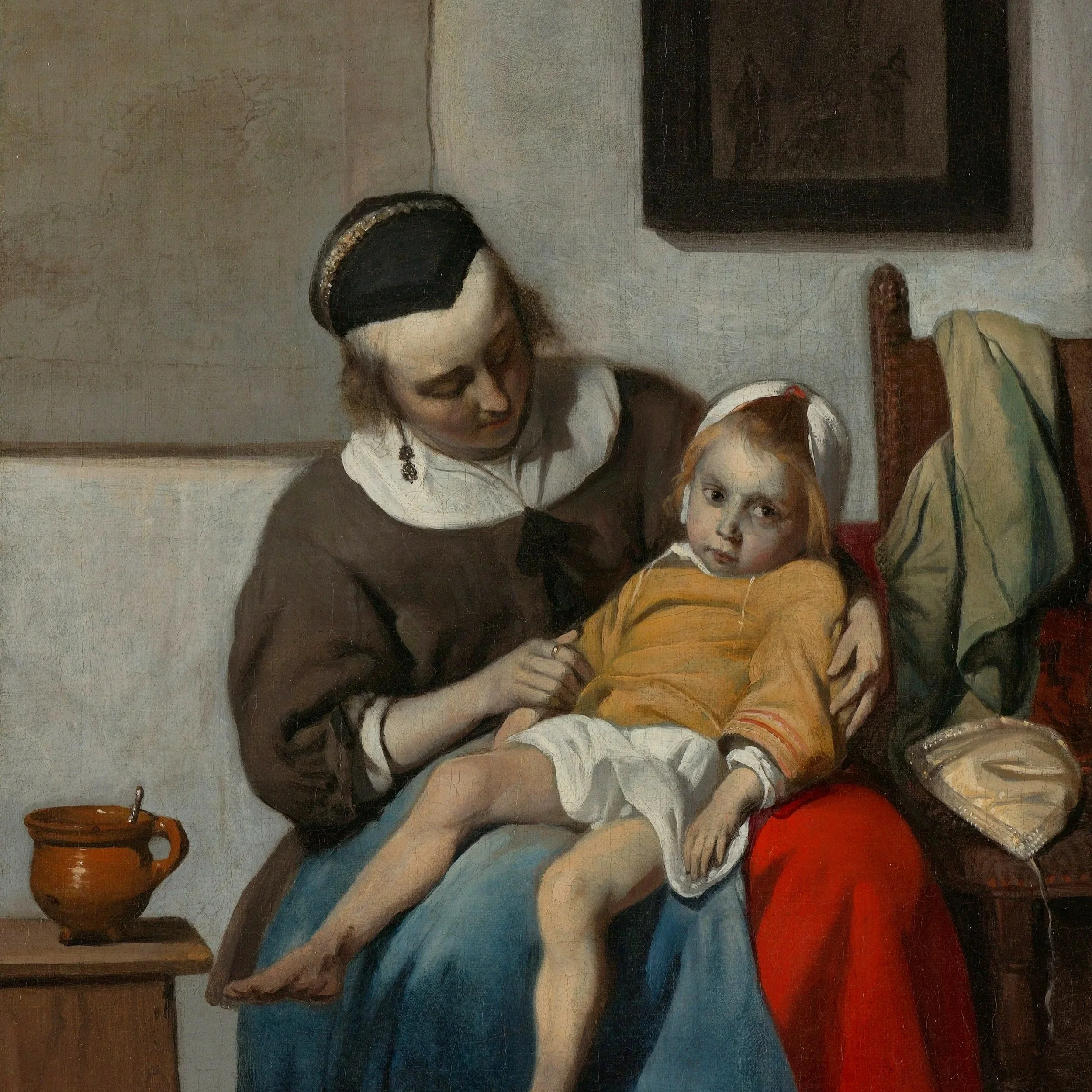
Gabriel Metsu, The Sick Child, oil on canvas, 1660-1665. Photo: Wikimedia Commons.
Leah Libresco Sargeant is the author of The Dignity of Dependence, as well as Arriving at Amen and Building the Benedict Option. She works on family policy in Washington, D.C. Her writing has appeared in The New York Times, The Washington Post, and elsewhere. She runs the Substack Other Feminisms, a Substack community focused on advocating for women in a world that makes an idol of autonomy.
Judd Baroff: Thank you for sitting down to do the interview.
Leah Sargeant: My pleasure!
JB: The first question is for those reading this interview who may not have heard of you, or haven't heard of the book. Please tell us what it's about.
LS: Sure. I'd say that the Dignity of Dependence is based around two core claims. First, that women's equality with men is not premised on our interchangeability with men. And second, that it is dependence, not autonomy, that's the base state of what it means to be human.
Part of the challenge is when we have this narrow sense of what normal is, what a ‘typical person’ is, a lot of people are left out. Not just women. Our sense of what it means to be human is too narrow for most men as well. But it's a mistake to try and treat people as though they're cogs in a machine who need to be standardized, fit the same shape, be easily hot-swappable, and it means we don't leave a lot of room for what makes us human.
Children are obviously a big part of that. The push to say ‘If only we could have free childcare from birth, so that children would never slow you down’ kind of misses the point of why you have children. It's trying to make children irrelevant to parents' existence, when, obviously, if that’s your feeling about children, you wouldn't have them. That’s the easiest way for them to be irrelevant to you.
JB: And for whom did you write the book? And I know a fine answer may be, ‘Well, everyone should read my book, make it a best seller,’ but usually people have an audience in mind. I'm curious who that was for you.
LS: I did try and squeeze in a couple audiences. Definitely a big part of my audience is people who are pro-life, who are looking for what can the pro-life movement look like after Dobbs. And I really want to make a pitch for a way of approaching and framing this that opens up conversations with people who don't think they want to have a conversation about abortion, or who believe they’ve had all the conversations they ever need to have about abortion. There's a real continuity between concerns people have for the voiceless and the idea that abortion is needed for women's equality, an idea which starts from the premise that it’s bad to be a woman. I'm hoping to take the pro-life movement and parts of feminism, and I’m hoping to try and make them kiss. I want there to be that door open on both sides.
And, you know, part of my book is always pitched towards people who are more skeptical of my claims. I’d say a lot of the first movement of the book is just convincing people that it is factually true, that we need each other. You might not like that fact, but given that it is true, you should think about how to respond to it in a way that is just and practical. And then in, I think, the eighth chapter, “The Blessings of Burdens,” I shift us along. “Υou’ve come this far with me. You agree that it’s true that we need each other, even though you may regret it. Now let me pitch you on the idea that it is good that we need each other.” That is, I do the is before the ought in the book. “Even if you hope for a fully transhumanist world, here we are” kind of thing. Let’s be practical.
“But I think it’d be very hard to think, who can I make that open-ended, big emergency ask of, if I hadn’t had a habit of making smaller asks and building up our relationship in that way.“
JB: Yes. Now I use the phrase cautiously but we’re both Catholic, so we live in a world with RadTrads. I think there’s a lot of room for people who aren’t RadTrad but who also don’t really feel comfortable with most of modernity, a middle ground which we can either uncover or recover.
So you write, “Women are the wrong shape for the designed world. In order to navigate it successfully, we are expected to find our own workarounds, build our own tools, or ‘fix’ our own bodies so that we can be better approximate the imagined ‘typical user.’ Often, the assistive device that is intended to give us access to the world doesn’t offer us equal access.”
And you just used that same phrase not that long ago, “the typical user.” I did an interview of Catherine Pakaluk a couple months ago about her recent book, and this reminds me of something we said there.
We’re now in 2025, and we’re looking back at the 1960s and the consequences of the 1960s, especially women going into the workforce. And we seem to focus on the ‘women leaving home and going into the workforce’ aspect, saying “look at all this bad stuff.” But if we were in 1925 and looking back to the 1860s, we’d be saying “look at all this bad stuff” and mean that men had left home to go into the workforce. It’s the same pattern just one hundred years after.
I’ve been playing around with this idea for a while, what if we’re not meant to be fully human like this? What if we (at least most of us) can’t both commute to the office for the 9-to-5 and be a fully realized human person? And I was wondering if you had some thoughts about that.
LS: I’ve been lucky enough for a decent amount of my working life to have either hybrid or remote work, which can be lonely in its own way, but I've used it as an opportunity to make bigger investments in my family and my neighborhood. I think when people leave the homestead, whether a farm or a family business, then there’s that question of, “Okay, well, how do we make horizontal connections between ourselves and our community in between work and dinner at home?” And I think it’s not that I want everyone to leave their offices, but the issue is we’ve lost some of the affordances that made those horizontal connections. What will we do deliberately to recultivate them?
So my second book, Building the Benedict Option, is a lot about how can you take one step deeper into community, wherever you are right now, even with a job and the long commute.
JB: Yes, you quote an economist, Alex Tabarrok, who points out, “it [both parents working] also means there’s little parental time that isn’t already allocated and assigned—it’s harder to deal with sudden shocks.”
Now, I haven’t read your second book and I know we’re talking about this one, but I’m too curious not to ask: what steps can we, even those families where both parents are in the office all the time, take to invest in their community—right now?
LS: The best start is just to invite people over, and invite people over immediately in the next week, not waiting for a special occasion, or for your house to be clean.
As a Catholic, I find an excuse to do this by just looking up whatever saint days are coming up. And I’m like, “Do you want to come over for the Feast of Saints Cyril and Methodius”? And it sounds like my invitation has more weight, because people are like, “Oh, this only happens once a year, I’d better say yes.” But secretly, I’ll just find another saint if you’re not available.
The goal is a lot more casual commerce with your neighbors, to drop in, to get together regularly, because that kind of repeated encounter makes it possible to love people more deeply.
We tend to think, “Well, I’ll wait and figure out who I like, then see them.” But it’s the act of seeing people repeatedly, and then sharing the stories. You’ll say, “Oh, do you remember that time when we all got distracted talking and no one realized that the kids were transferring the cereal one flake at a time to a plate for reasons that were never fully understood?”
And that becomes a bizarre, arbitrary cornerstone of your friendship. I think we expect too much that our friendships are not a little arbitrary. And we have a lot of capacity to love whoever we find ourselves in contact with.
JB: As I said, we homeschool, and for all we’ve built our lives around that, I think what you’re talking about here is one of the good things about a parish school or a public school. It really throws people of wildly disparate experiences together for long amounts of time.
LS: Yeah, I think parishes are a huge part of that. Because in my experience, it’s often at church that I see people who have the greatest age difference from myself, socioeconomic difference from myself, disabilities. It’s easy to find yourself in a very narrow lane of life, where it’s me and all the other thirty-something policy wonks, right? It takes a space like church to be broken open to the rest of the world.
JB: Exactly right. Now, as the title says, this book is about dependence. You write, “We are called, not to accommodate dependence as a brute, unpleasant fact, but to knit dependence deeply into our understanding of what it means to be a human being. Our ties to others are not an obstacle to self-actualization, they are the foundation for the authentic self. It is the places we are exposed to the world, our vulnerabilities, that allow us to extend ourselves in love and receive love in return […] After we acknowledge the reality that our lives are not our own, that we cannot remain untouched by the needs of others, we still face a choice about how to respond to the pull.”
So you just pointed it out, and you point it out throughout your book, the idea that we are dependent creatures gets the hackles up of basically everyone in our modern culture. Would you tell us why you think that is and how you have found success in trying to get past those barriers?
LS: I think what you said is right, that everyone, even when they’re on board in some places, finds some moments where dependence kind of rankles them. And a lot of my goal is to follow in the footsteps of C.S. Lewis in The Great Divorce or The Screwtape Letters. You’ll be reading things, and you kind of see these descriptions of rejecting the reality of the world, and you go, “Oh, that’s ridiculous, how could we treat women that way? How could we treat babies that way?” And then you come up to some part about aging and you say, “This is what I’m doing!” That’s my experience reading those books.
I keep showing where we reject weakness and you can see the illogic and inhumanity again and again, but there’s some moment where it’s a sticking point for you. And hopefully by seeing them all interleaved together, you can carry over those moments where you are in touch with what’s right to those moments where you really struggle with it. For a lot of folks, the sticking point comes with their own weakness. It’s easier to be charitable with someone else’s need while feeling ashamed of one’s own.
I have a couple examples in the book of people who were helpers to others but were ashamed or reluctant to reveal the ways they needed their neighbors. If you do that, even as you try and help others, you’re indirectly catechizing them that being helped is shameful. Because if you believe it’s shameful for you to ask for help, it does imply that whenever you’re helping your neighbor, you’re condescending to them in some way, or humiliating them. I think no one would say that straight out, but it’s built into the way that we’re so protective of our own weakness.
JB: I’m wondering how you, on a personal level, or how you’ve seen others, navigate this. Because there is a danger of not giving enough effort, right? Like if you’re running a marathon, you can come up against this wall where all you think is “I can’t do this, I can’t do this, I can’t do this.” But then you keep going and you break through that wall and you have all this energy afterwards to the point that it might even seem easy in retrospect.
Now, I’ve never actually run a marathon, but I’ve been told stories. And I suspect we all have our own experiences with like phenomena. For me the most obvious example I’ve actually gone through is with parenting. I’ll be struggling along, “I can’t do this anymore, I can’t do this anymore…” And then, because there’s no option, I just continue and find out that actually, yes, I could do it all along, and it was both easier and more enjoyable than I thought.
So how do we navigate the space where we don’t ask for help too soon and therefore never get to see how much more capacity we truly have while also feeling comfortable, unashamed of, asking for help when we really do need it?
LS: It’s good to have the habit of asking for help sometimes when you’re not in extremis, where you haven’t exhausted everything that’s available to you. Just to keep up the habit. Because if you have practice asking for help in moments where you can hear “No” and nothing bad will happen, then hopefully in those moments where you desperately need a “Yes,” you have people you’ve asked repeatedly, with whom you have a relationship and from whom you feel comfortable making that bigger ask.
I try and live this out. There’re moments where I ask my friends for things, like, “Do you have this piece of a Halloween costume I need?” The most trivial of asks. “Would you mind driving my kids to school because it’s raining really hard and I don’t want to bike?” That’s doable.
And then I had to make a big ask, which was, “It turns out I’m headed to the ER right now. Can you pick up my kids from school and then just keep them at your house indefinitely till my husband and I figure out what's happening?” And people said yes! But I think it’d be very hard to think, who can I make that open-ended, big emergency ask of, if I hadn’t had a habit of making smaller asks and building up our relationship in that way.
JB: That’s great. I don’t know if this is apocryphal, but it reminds me that Ben Franklin famously said, even if he never actually said, “the best way to make people like you is not to do things for them, but to ask them to do things for you.”
LS: Yes, and I think that’s true because it creates a bond of kindness, and it’s intimate. I think we are nervous about it because it is intimate. But when you ask for help with something you genuinely need, you are exposing yourself to someone. You’re not being crisp, professional, perfect. And intimacy is the seed of love.
JB: You talk about that, about how the family is the first place we get exposed to weakness and need. You have these back-to-back examples where you talk about your daughters while you were pregnant with your son. “No, actually, you cannot actually jump on Mama’s belly anymore, thank you very much.”
And then you have this particularly touching story about the last year of your father’s life, where he would come over and just light up when your daughter was about, and then he’d go dormant, in a way, when she went down for her nap. And I was reminded of my grandmother, who’s celebrating her 99th birthday soon. That’s basically where she’s at.
And so I’m wondering if you’d like to talk a little more about the, for lack of a better word, dangers we run across in not having these large families anymore. You talk in particular about how few cousins we have and about their importance.
LS: Yeah, as families get smaller, there are fewer and fewer cousins to go around, and one of the benefits of cousins is that they’re people you have to love who are part of your family. It multiplies how many unchosen, beloved people are in your life. And I think that’s good practice for loving all the people we’re freer to walk away from—our neighbors, our friends, our coworkers. Our family is our tutorial in loving people we did not choose for ourselves.
Cousins are a little more at arm’s length, so they can be much more different from your family. They live by different rules than in your house—different rules about dessert, very controversial, right? And bigger things, values things, but you still know they’re part of your family forever. And that changes how you can interact with them and what your responsibility to patch things up is.
It’s harder to live as citizens alongside each other without practice in loving people we’re stuck with forever, who we know personally.
JB: Yeah. Another benefit to the parish system, which is breaking down a bit in the modern world. But it used to be that you would just show up at your local parish, and whomever you sat next to, well they would be the people you were stuck with. But now people parish-shop a little more.
LS: They do parish-shop, but there’s really no alternative. I think it’s rare for people to know what parish boundaries they live in unless they live very close to a church. So, you know, it’s very understandable why people just try and figure out, what church do I like? There’s no sense that anyone tells you what church you do belong to.
JB: That’s a good correction. In fact, as you were talking, I was sitting here wondering, “Wait a second, actually, there’s another parish which is in the opposite direction, which we might more properly belong to.” You know, it’s North and we go East.
LS: It’s easy for me because it’s a walk to my church, so I’m pretty confident I am in my parish boundaries. But of course, I did parish-shop by choosing where to live.
JB: You chose the house with the parish in mind?
LS: Yes. Very much so, because there’s a strong community around it. In our neighborhood, if you have a baby, and this is coordinated through the moms of the parish, you get ten meals. And they might be from strangers, which I think is particularly lovely.
I’ve had meal trains before, you know, organized by friends, carried out by friends, but here it is carried out by the neighborhood. So I might meet someone for the first time at the door as they hand me the casserole.
JB: That’s very nice.
One of the things your book does uncommonly well is consider the quantification problems before us. You write, “The problem is letting the language of wages and equal exchange become the dominant image for relationships of intimacy and dependence.”
For example, and now I’m summarizing, you write that if two stay-at-home mothers swapped their children and paid each other $30,000 a year to care for them, the economy would grow by $60,000. (And you have this great aside about how in that case the federal and state governments would be sure to take their cut.) But if the mothers did the same work themselves, and of course they would do a fuller job of the work at their own homes with their own children, those earnings disappear from our view.
Then you quote this economist, Nancy Folbre, who says, “If you marry your housekeeper, you lower GDP. If you put your mother in a nursing home, you increase GDP.”
Finally, you write, “The calculator [of Washington Post writer Alyssa Rosenberg] suggests that my breastfeeding was a lot more valuable when I did it for my second child as chief of staff at a non-profit than when I fed my first baby while working in a campus ministry. The wage-scaled number is helpful as a measure of opportunity cost—what I might be giving up while stepping back from work or shifting to limited hours—but it’s a bad portrait of value. My nursing isn’t more valuable than that of a mom with a minimum wage just because my forgone wages might be higher.” (my emphasis)
So it seems to me that we’re living and valuing our time in market logic, working abroad is paying for the work that we forego at home. This seems like a profound problem.
LS: Yes, it’s a big challenge for families, and I’m in a family where we have a mix. I both work outside the home and at home. I do childcare and I pay someone to do some of the childcare. That’s happening right now or else we wouldn’t be having this conversation. But I think the key thing is that when we look at things through the lens of what’s measurable, it’s helpful but crude and it leaves a lot out. We have to consider what this measure is blind to. How do we make sure we’re valuing and protecting those?
Because the language of economics and wages is so prevalent, there’s an attempt to retreat to it as the only legitimate way of staking out value. Because it’s neutral, right? We can all agree wages are objective, they’re real, they’re numerable. And so you get that tendency to say, “Well, what does nursing cost women? Let’s judge it by foregone wages.” And that’s just clearly not the right way of measuring this. It can help people spark a conversation if we’re just trying to say it’s not trivial for women to nurse, that there are choices and trade-offs they make. But we always have to leave space in our conversation for discussion of real values, not just measures and figures.
JB: Yes, and I think you do a good job of pointing out that there’re some jobs that don’t function in an equal exchange. The nanny who is presumably watching your son right now, the nurse at the old people’s home or even the one at the hospital, we’re not making the same neat economic exchanges with them as we would with the clerk when buying a new iPhone or when we shop for groceries.
You write, “A buyer of care will find that they cannot easily switch to a new, cheaper caregiver who does ‘equivalent’ work because the new caregiver lacks a history with the person in need of care.”
LS: That’s right. This is where hoping that we can find parts of our lives interchangeable, or ways to treat humans interchangeably, clearly breaks down. If I switch nannies mid-year, even if I’m getting “equivalent” care, even at a cheaper price, I’m now engaging with someone who hasn’t seen my son learn his first words, doesn’t have this sense of where he’s been and where he’s going. Now, that may turn out to be the right choice for my family, but you just can’t look at the provision of care as equivalent to getting new bananas week to week. We can get some of an arbitrary set of bananas, and which ones doesn’t matter too much.
JB: There were these two quotations which I found very striking, about hormonal birth control. And I don’t think people know the effects birth control has. But the point also isn’t just about birth control.
You write, “Sophie wasn’t in a relationship, so she had felt like there was no need to be on birth control. But her time off the Pill convinced her that her chosen life was compatible only with her medicated self. She went back on contraception, not to avoid pregnancy, but as a performance-enhancing drug for office life.”
And then, “Once she had returned to natural cycles postpartum, Olivia was surprised by how strong her sexual desire could be—and how little her husband attracted her. She ultimately began an affair with a judge. Going off the Pill changed how she felt and how she understood herself. ‘I felt like this sexual tigress, and it was so startling to me,’ Olvia said. ‘I wondered whether everything that I thought to be true about me in the last decade was a lie.’”
You then compare these women on the Pill who then come off the drug to anorexics who, even after they free themselves from the false image of anorexia, don’t immediately go back to healthy eating habits. And I think we can all see this, not just with medical conditions, not just with things like hormonal birth control, but even with technology like a video game addiction or getting too obsessed with Twitter, where we have to take a step back and, as you write, “encounter [ourselves] as stranger[s].”
LS: Yeah, these examples are drawn from Dr. Sarah Hill’s This Is Your Brain on Birth Control, which I really appreciated, and for some of the women she profiles, there’s a sense that part of what they get out of birth control is just a flatter, more predictable way of being in the world. The natural cycles have more ups and more downs. There’s a real pitch for birth control that it’s easier to approach your life when your life is less variable. That means the lows are not as low, but the highs are not as high either, and I think that’s one of the questions we need to ask about birth control. Because there’re a lot of different trade-offs people make in choosing birth control, but there’re a lot of attempts to make life flatter and more predictable so that it can mesh better into your job. There’s a sense that it’s better to exist in this narrower range than to have the full range of human life.
JB: You give this hilarious example of an advertisement. It’s for the amphetamines that they used to give housewives, and it includes one of these brutal asides you sometimes give. You say, “Today, doctors don’t casually dispense amphetamines, at least not to adults.” But, “More and more children are on Adderall or Ritalin to help them better fit the expectations of their classrooms.”
LS: And it’s not that there’s no role for particular medications, for Adderall or antidepressants, but when the use rates get so high, I think it’s worth asking, “Are a lot of people having a congenital difficulty that requires medication, or are we asking things of people that aren’t sustainable for anyone, using medication to backfill the gap?”
So, with any individual person, I wouldn’t say, “You, in particular, have made a mistake in using this medication.” But, on the aggregate level, when you look at the rates of people on antidepressants, you have to ask, “Okay, is this the natural rate of depression or is this a response to being asked to do more than a human can do, and then feeling depressed?”
Because you run into both young boys who are just having trouble sitting still for so long, but also people who work very demanding jobs, and the assumption is people will take these drugs as a way of getting their job done in the same way that bankers have taken cocaine to stay up all night making deals. And one of them comes from a doctor, but I think the question is always, “let’s pause and look at how much time do you spend at work? Is this a sustainable amount of time for anyone to spend without the help of drugs? Should there be jobs that require drug use to do for almost everyone?”
JB: That goes to another one of the themes of your book, which I’ll summarize as “however much you want to be independent, to handle your universe, eventually all of us face debility, which is sickness and death of course but other times of slowing down like with age and pregnancy. We all have needed and most will need assistance in our lives.”
You write, “Philosophy was, in Socrates’s thinking, a preparation for death. In our present, more secular age, death is not necessarily seen as the key challenge that tests our character. The stakes of death have gotten lower. A society that is skeptical of the soul is more prone to see death as a mere cessation, rather than a birth into new life or a reckoning with the life we have lived. Instead of desiring preparation for the mystery of death, our age is hungry for philosophy that can serve as preparation for debility, decay, dependence. The fruit of death is hidden from us, but the scope of need is not.”
Now it seems to me that those who do not believe in a Hereafter look at death, and, as you say, see it as an ending of everything, and they run frantically away at great speed. Think of Bryan Johnson, whom I think of as “the vampire guy” because he literally was taking his son’s blood and putting it through his veins. They’re terrified of death.
And then I think of our Tradition. We have this phrase, Memento Mori, remember that you shall die. So I was hoping that you would speak to what we might learn from other cultures, like that ancient, careful burial in Vietnam of a disabled youth in your book, and what we can learn from our own past culture about facing debility.
LS: One thing that’s very difficult about the present is that death is pretty abstract and distant. You can think about it like this, for many people the first time that they’re playing a major role by a deathbed is when their parents are preparing to die. And if you think about it, having this big duty to discharge for your parents, do you want to approach it as an amateur, as someone doing it for the first time?
JB: Ah, I see.
LS: Or do you want a little more practice under your belt? And I think pretty obviously you’re better off with the practice. If you want to be steadfast for your parents, then you want to be around more people dying for practice. And that used to be common, both because it was much more common for people to die at a range of ages and because families were larger, so there was more tragedy sprinkled in, just with the law of large numbers.
And we’re very lucky to live in a society that’s so prosperous and has made so many medical advances that death feels rare and distant. That’s a real gift, and I don’t want to see us reacquire our familiarity with death by slipping backwards there. But because it’s more distant, we have to take an active step forward to figure out what it looks like to die well.
How can I spend time with people who are dying to shape what I want to do for my parents, what I want for me, &c?
JB: Yes. Now, the most common recurring thought I had while reading your book was that this world needs a revolution. I’m not going to say “burn it all down” because we don’t want to live in the ashes, but you actually write about this near the beginning. “Building a just society requires a moral revolution. When we have used a false anthropology as the foundation of our culture, dismantling that lie is costly. There are good things that have been built on that pile of tiny bodies.”
And what you’re talking about with “that pile of tiny bodies” is the supposed freedom abortion gives women. So as we’re closing out here, I feel like it’s a good time to ask: What are those good things? What do we want to preserve, and what do you think can be safely cast aside?
LS: It’s kind of true descriptively what Ruth Bader Ginsburg said in her original attempts to find a Constitutional framework for abortion access, which is that abortion is the entry ticket to society as we’ve constructed it. That’s because men are able to walk away from a baby, even though it might be an act of cowardice to do so, and so women struggle when they’re not given an equivalent way of abandoning someone.
Now Ginsburg viewed that as more morally neutral than obviously I do. But I think the sense that people are, by default, autonomous, and that their relationships are only legitimate insofar as they’re chosen, means that it’s hard for women to be treated fairly when we treat the real bonds of family as though they’re an expensive hobby that you’ve opted into, a form of self-expression, not the base reality of how we all come into the world.
JB: You write about different ways people can gain access to their community. In closing, are there ways to enmesh ourselves in community, in this web of dependencies, that you’ve found since you’ve written the book?
LS: What I’d love to leave people with, is just wherever you are, there’s something you could use help with. Really think, in the next week, how could I ask someone for help? Asking opens the door for these small connections, for this web of giving and receiving that allows both you and your neighbors to fall back on each other in moments of greater need.
The lucky thing is, no one in the world is at a loss for something they could ask of their neighbor.
JB: And now to the people who have stumbled across this interview, besides going out and buying the book, where should they go to learn more?
LS: The best place to find me on this project is my Substack, Other Feminisms. That’s with the “S” at the end, to make it clear it’s a big tent. It’s a really lovely community. I hope it’s a return to the best of blogging, where there’s a lively, thoughtful commentariat who doesn’t agree with each other on everything, but who are willing to collaborate and disagree.
JB: And are there any other projects you’re working on that we should be paying attention to?
LS: I’m raising three kids, so that’s one of my big projects.
And to make that easier for me and for everyone else, for future babies, in my work as a public policy analyst, I’m advocating for a Baby Bonus. It’s a way of just supporting parents right from the outset with money that comes right after birth to help them handle the turbulence of welcoming a new child.
JB: That’s wonderful. Thank you so much.
LS: My pleasure! Have a great morning!