The Diplomatic Revolution: In Search of a Trump Doctrine
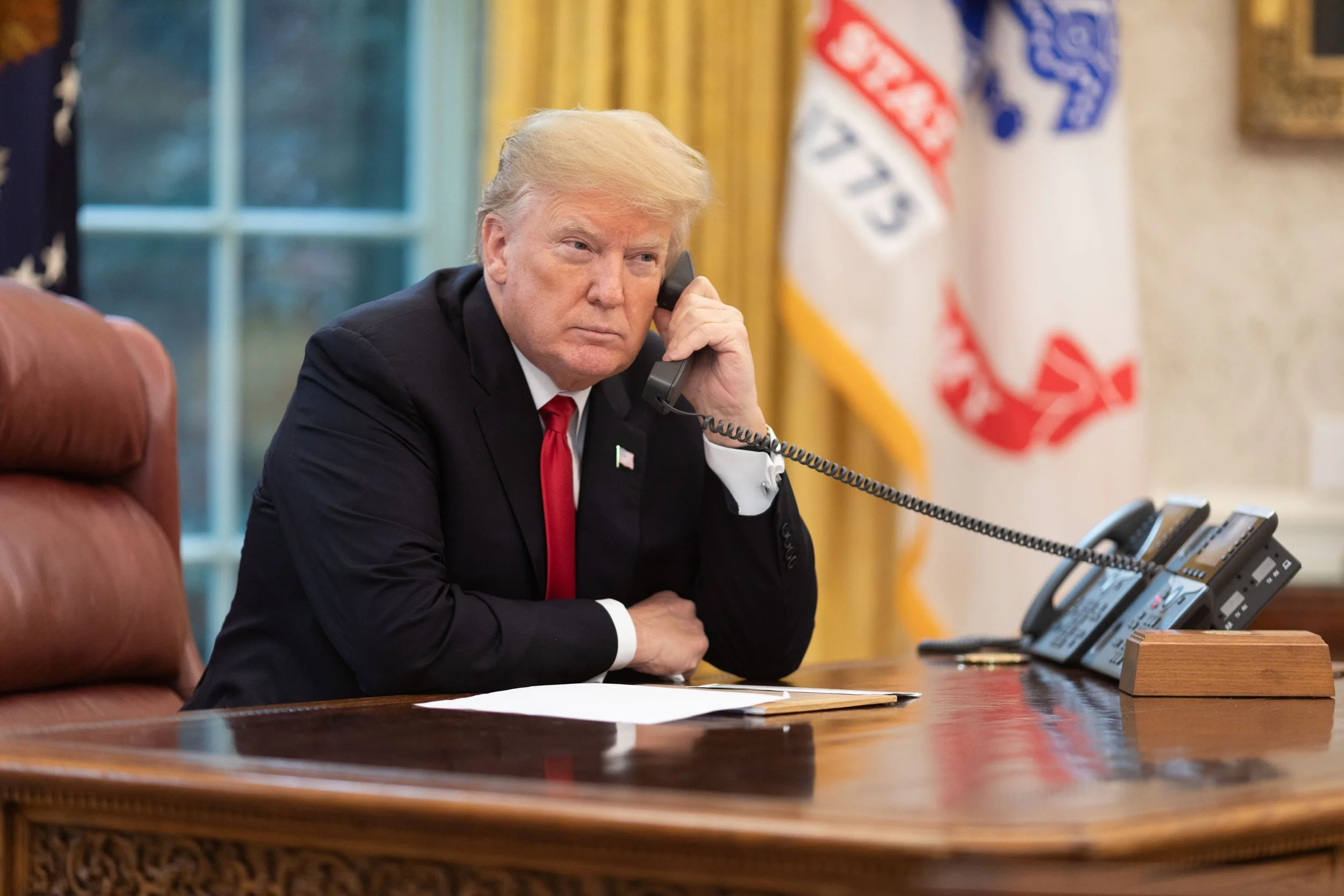
President Trump in the Oval Office. Photo: Wikimedia Commons.
A version of this essay originally appeared on the author’s blog, The Diplomatic Pouch, on November 12th, 2025. It has been substantially
reproduced here with permission.
Throughout America’s history, the republic has seen several decisive shifts in the conduct and theory of our foreign policy. After independence, we largely restricted ourselves to affairs in the New World. The settling of the interior and our victory against Spain at the end of the nineteenth century drove America to build an empire in the Pacific. Two world wars soon forced the US to seriously engage with the other great powers, either defeating or partnering with them. Then, the Cold War drew America into a protracted struggle for global hegemony. The defeat of the Soviet Union brought about a new era of American power. After 1991, the US faced no nation that could pose a clear threat to our newfound hegemony, which we sought to consolidate through what is often called the Liberal (or rules-based) World Order. America’s policymakers hoped this system would formalize the existing status quo and in doing so, locked in the US as the only global superpower. Instead, US global power was deeply shaken in the aftermath of the 2008 financial crisis, and rivals like Russia and China began to assert their power.
Now, the second Trump administration is leading a revolt against the system that America itself built. They argue that regardless of the theory behind the Liberal World Order, it has failed to serve the United States. It is clear that we have now entered an era of global transition between world orders. As the Prime Minister of Singapore said a few weeks ago, “we are in an uncomfortable position, where the old rules do not apply anymore, but the new ones have not been written.” What we are seeing now from the Trump administration, and will likely continue to see over the next three years, is an attempt to write those new rules.
The point of this article is to describe the foreign policy philosophy behind the Trump administration. It is not written to judge that philosophy, or its practical consequences. I will consider this article a success if both supporters and opponents of this administration agree I’m accurately describing the underlying views that drive its foreign policy.
“Trump has a deeply held view that America’s allies are taking advantage of it.“
Before delving into the topic in full, it’s worth describing why this article is necessary at all. It has much to do with the specific nature of the current administration. No man rules alone, and no cabinet is a monolith, but usually the critical decision makers in an administration have more in common than not. President Trump, meanwhile, has surrounded himself with advisors of radically different persuasions, and it is difficult to say how much sway any one member of the administration has over our foreign policy. JD Vance and Elbridge Colby have their victories, but so do Marco Rubio and the GOP’s hawkish old guard. Given these internal scuffles, the administration has unsurprisingly failed to articulate in detail a cohesive grand strategy. Instead, we are forced to gather up all the actions, utterances, impulses, tweets, and stump speeches in search of a single Trump Doctrine. To the extent that a single approach does exist, it incorporates the following core principles.
Rejection of the Post-1991 Liberal World Order
Using Wikipedia’s definition, the Liberal World Order (or Liberal International Order, LIO) “entails international cooperation through multilateral institutions (like the United Nations, World Trade Organization and International Monetary Fund) and is constituted by human equality (freedom, rule of law and human rights), open markets, security cooperation, promotion of liberal democracy, and monetary cooperation.” The US has had an imperfect and uneven relationship with the LIO since its inception in 1945 and ascension to global dominance in 1991. On one hand, America (particularly the FDR and Truman administrations) was the driving force behind both the norms and the institutions that made up the LIO. On the other hand, the US has consistently flouted the very rules it laid down. This shouldn’t be so shocking—America asserted itself as a hegemonic power immediately in the wake of WWII, able to act without international approval. What we are seeing now, however, is less the practical rule-bending of a great power and more the philosophical rejection of a system that the president and his advisors no longer view as advantageous to the national interest.
In place of the LIO, the Trump Doctrine wants what I would call a quasi-multipolar world. For those that don’t know the international relations jargon, there are several different forms of world order. A unipolar world is one with a single global hegemon, which no state or alliance of states can effectively challenge. A bipolar world is one where two major powers duel for dominance, forcing secondary powers to pick sides. A multipolar world has a number of feuding great powers, each struggling to maintain dominance over a collection of subordinate states. In the Trump Doctrine, the world is divided into two zones. First, a region that encompasses the New World and parts of East Asia, which are seen as exclusively in America’s sphere of influence. In this region, the Trump Doctrine is more comfortable exerting force and expects nations (which it views as essentially client regimes) to comply with American wishes unquestioningly. The failure to do so, be it by allies like Canada, partners like Mexico, or enemies like Venezuela, will be met with a disproportionate response. Outside of the American sphere, the Trump Doctrine reserves a right for the US to interfere as we see fit, but does not include an expectation of such intervention. Notably the doctrine seems to include some willingness to recognize the spheres of other great powers like Russia or China, but only as part of a larger deal that grants America important concessions. Needless to say, all of this represents a substantial shift from American thinking since 1991.
Dislike of International Institutions and Commitments
The American right has never had a particularly favorable relationship with international law and integration. A Republican-dominated senate rejected US entry to the League of Nations in 1919, Republican isolationists led the opposition to the UN in the immediate postwar period, and Senate Republicans have ensured that the US is not a party to dozens, if not hundreds, of international agreements regulating everything from the Law of the Sea to land mines. The GOP has consistently demonstrated skepticism towards global political and economic integration, with a major exception being firm support for free trade agreements from 1980 through 2012. This period is bookended by both the Nixon and Trump preference for aggressive and unilateral moves, international institutions be damned.
In much of this, the Trump Doctrine is more continuity than change. What stands out as starkly different, however, is the current administration’s questioning of America’s security ties. This is new. Pearl Harbor killed American isolationism, and the Cold War forced us to build a global security architecture. Between 1945 and 1991, Republicans and Democrats worked together to create and expand NATO, forge alliances with Asian and Middle Eastern states, and build a network of American partners and proxies worldwide. After the Soviet Empire collapsed, we expanded our constellation of alliances further still, even if the threat of war now seemed distant. These alliances were sometimes founded on the basis of common values like democracy and freedom, but just as often they were sheerly pragmatic partnerships with despotisms and monarchies like KMT-ruled Taiwan or Saudi Arabia.
The Trump Doctrine represents a shift from the standard postwar GOP stance by viewing these relationships as liabilities, not assets. President Trump’s rocky relationship with our European NATO allies is the prime example, but the president generally doesn’t put much stock in formal, especially multilateral, treaty agreements. This dislike of standing institutions that lock the US into commitments probably comes from two places. First, their nature is very much contrary to his personal style. The Trump Doctrine prioritizes flexibility and freedom of action, which is impeded by formal agreements. The second reason is more fundamental, and one that he has articulated in interviews since the 1980s. Trump has a deeply held view that America’s allies are taking advantage of it. This includes, of course, trade agreements. He always disliked the free trade consensus, and thought that countries were “screwing us over” by protecting their own markets while we opened ours. But beyond trade, now-president Trump feels institutions like NATO are an elaborate subsidy scheme, allowing the Europeans to mooch off American largesse and military might, while not meeting defense obligations.
So what does the Trump Doctrine want in the place of an established network of treaties, alliances, and stable relationships? In short, diplomacy on a bilateral, transactional, direct, and ad hoc basis. One that keeps formal commitments by the US to a minimum, while in turn extracting maximal commitments from other countries. Instead of establishing standing organizations to mediate and formalize cooperation, the administration prioritizes flexibility and the ability to enter and exit situations as it chooses. To achieve this, they are willing to downsize longstanding US involvement in international bodies and to accept the resulting hit to credibility.
Rethinking “Values-Based Diplomacy”
Conservatives have criticized what is known as “values-based diplomacy” (a term that typically refers to diplomacy based on values rather than on purely strategic considerations) for some time. They view it as a continuation of Wilsonian moral grandstanding, the sort that sacrifices tangible security interests for hand-wringing over human rights violations. An excellent example of this would be the differing Republican and Democratic approaches to Saudi Arabia. Liberals often find our close relationship with the absolute monarchy to be morally indefensible, while conservatives view them as a critical ally against a hostile Iran, regardless of their distasteful domestic politics. The Trump administration has adopted the longstanding language of the GOP in this regard, but has taken it in a radically new direction. Where Republican presidents like George W. Bush were great advocates of foreign aid and humanitarian work, the Trump administration has largely dismissed the usefulness of soft power. The gutting of USAID and the closure of VoA (America’s overseas broadcaster) are probably the most notable examples of this. But below the surface, we have seen a more uneasy relationship between the rhetoric used to attack the Biden administration’s foreign policy and their own actions. Instead of entirely abandoning the role of values in foreign policy, we have instead seen the administration act on values they see as central to their own priorities. Take three examples:
President Trump sees himself as persecuted by liberals entrenched in the deep state and judiciary, and as such has publicly demanded that the (generally liberal) Israeli and Brazilian judicial systems halt their prosecution of Netanyahu and Bolsonaro, respectively.
Immigration was a central campaign theme in 2016, 2020, and 2024, and obviously requires foreign policy coordination. Unrelated to this requirement, senior administration officials have launched broadsides at EU governments for allowing Muslim migration into their countries, an issue that has no clear relevance to America’s own migration challenges.
MAGA views the Western liberal establishment as anti-free-speech, especially the speech of right-wing populists. Driven by that concern, the administration has prioritized the speech rights of right-wing figures abroad, especially in our allies. This has led to the US sanctioning a Brazilian supreme court justice and a drumbeat of negative comments about the UK from Vice President Vance.
All of these complaints make complete ideological sense for MAGA and the current administration. That being said, involving ourselves deeply in the internal affairs of democratic allies to try and enforce a US administration’s domestic priorities, is unprecedented. In the early days of the administration, when Vice President Vance was preaching the value of a realist foreign policy, I remember someone instead calling him an “illiberal idealist.” I think that may be overstating it, but it’s an interesting frame of reference, if nothing else. It highlights the awkward similarities between the Trump Doctrine and the Biden-era human rights agenda, which was blasted as a globalist project and a waste of taxpayer dollars. The Trump Doctrine certainly claims to be driven by a realist mindset, but seems to instead push a values-based agenda of its own, just espousing a new set of values. In truth, though, this should not come as a surprise. The human species is full of ideals, and America is a nation founded on values and a vision. How could any American approach to foreign policy truly be without a value set of its own?
Distrust of the Diplomatic Establishment
It should be clear by this point that the Trump Doctrine judges the last decades of US foreign policy to be ill-conceived at best, and malicious sabotage at worst. It is that assessment which drives the last core element of the Doctrine: a deep distrust of professional diplomats, and more broadly, the foreign policy establishment. Moderate figures in MAGA view them as a coalition of incompetents that have led us down a path to nowhere, feeding off arrogance born from the collapse of the Soviet Union. More hardline figures focus on the existence of a shadowy elite that has prioritized the rest of the world over America. For them, the fight against left-wing globalists is not just ideological, but a matter of purging the personnel that have pushed this agenda from the civil service and the party.
So then, what exactly is it that the Trump Doctrine disagrees with the “foreign policy establishment” most strongly about? First, everything we’ve discussed above; what they view to be the subordination of US interests to an internationalist order that is spreading a destructive value set. When you get into more concrete policy questions, things become more hazy. A common talking point is rejection of “forever wars,” by which they principally (but not exclusively) mean involvement in the Middle East. If you ask JD Vance what was the worst US foreign policy mistake of the last twenty-five years, he would probably say the Iraq War. This, of course, represents a deep rejection of the Bush II foreign policy legacy. The dislike of global military adventurism is exemplified today in US policy towards Ukraine. The Trump Doctrine views it as essentially not our fight; to the extent America does have an interest, it is in a swift resolution of the conflict and as a way to force Europe to spend more on defense.
A clear and very distinct feature of the Trump Doctrine is the tendency to use personal associates and friends to circumvent the State Department and foreign policy professionals. Tom Barrack and Steve Witkoff, two longtime associates of President Trump from his pre-2016 life, have become perhaps the most influential practitioners in the second administration, arguably eclipsing even Marco Rubio. Their personal loyalty to the president aside, their inexperience is seen as a strength. Rather than being tarnished by decades of foreign policy wrongthink, Witkoff and Barrack come from a business world, which the president feels is a far better preparation for the sort of dealmaking he’s interested in.
An All-of-Government Approach
Another defining aspect in this administration has been an unorthodox “all-of-government” approach to problems. While the State Department tends to go about things with a linear and mechanical process, this administration has adopted a starkly different approach, where traditionally unrelated issues are linked to create maximum pressure. Given America’s position at the center of the Western economic and security architecture, it has a great deal of potential leverage. Foreign aid, weapons sales, joint infrastructure projects, tariffs, migration agreements, visa-free travel, strategic materials, and a historically open market all facilitate this. If we applied pressure on a reciprocal basis (trade pressure on a trade issue), it might not be sufficient to force concessions; but hitting on a number of fronts all at once is more likely to force a capitulation. This was starkly apparent earlier this year, when tariff threats (amongst other potential pressure points) were used to bring Thailand and Cambodia to the negotiating table over a border dispute. The dynamics with Canada and Mexico have seen a similar all-of-government approach. Complaints about dumping, migration, labor practices, organized crime, fentanyl, alignment with China, subsidy, and a laundry list of other issues have all been tied together to maximize leverage for a future settlement.
This strategy obviously has substantial benefits, but it also carries real risks. China’s use of its rare earths leverage against the US has catalyzed an aggressive program to build up our domestic rare earth mining and refining capacity, while the US’s employment of sanctions on Russia pushed Moscow to build alternative financial infrastructure. In short, most leverage is a single-shot gun: once used, the other party will move to minimize their exposure to it. So the use of America’s leverage against partners and allies will not only anger them, but will actually push them to decouple from the US order to the extent that is practical, in fear that their vulnerability to pressure from Washington will only invite future demands.
A Final Assessment
With all this being said, there is one critical fact left to recall. The Trump coalition is not a monolith but, rather, a heterogenous coalition of feuding cliques. President Trump, meanwhile, has not written a magnum opus on foreign policy, and is not likely to do so in the coming years. Because of that, no search for a single Trump Doctrine can ever be complete. Even without that clarity, it is clear that a sea change has taken place. I have no doubt that in the coming years and decades, when the president leaves office and eventually dies, there will be a tremendous battle amongst his successors in the GOP to define what Trumpism really means. Much like Peronism in Argentina, and Kemalism in Turkey, the president’s ideological legacy will rattle through the system for decades, as competing factions each declare themselves to be the true heirs to the Trump Doctrine, at home and abroad.