Dwelling in the Haze: Reflections on Nolan’s The Odyssey
It is an intractable truth that adaptations will always reveal more about their target audience’s cultures and values than those of the original material’s audience.
What then does Nolan’s Odyssey reflect about ours?
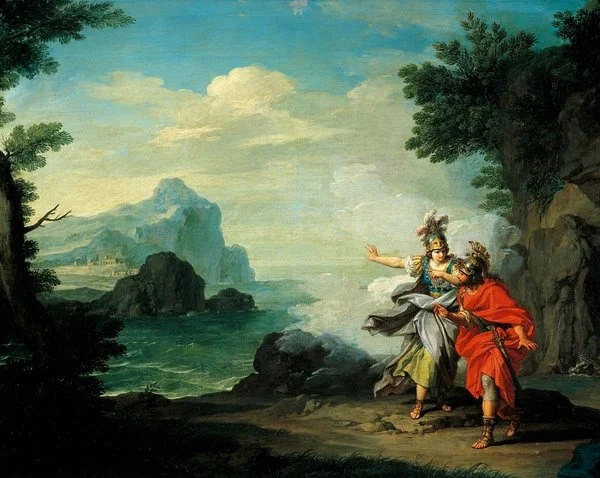
Giuseppe Bottani, Athena revealing Ithaca to Ulysses, oil on canvas, 18th century. (Photo: Wikimedia Commons)
This article is the third in a series of reviews of and reflections on Christopher Nolan’s 2026 film The Odyssey. Reviews do not necessarily reflect the views of the editors.
For the full twenty years Odysseus has been kept from Ithaca, his actual arrival is surprisingly achieved without much fuss. No more Lotus-Eaters, or cannibal giants, or cyclopes, or witches, or monsters, or storms churned by wrathful Poseidon. Instead, he is gently deposited—still sleeping wrapped up in a linen sheet—on the coast of his kingdom by the Phaeacians, lovers of the oar, along with the bronze and golden treasures bestowed by King Alcinous and the other lords of Scheria. Perhaps it is this rare, serene landing for the adventurer that discombobulates him, as he wakes and fails to recognize his home:
Odysseus awoke out of his sleep in his native land. Yet he knew it not after his long absence, for about him the goddess had shed a mist, even Pallas Athena, daughter of Zeus, that she might render him unknown, and tell him all things, so that his wife might not know him, nor his townsfolk, nor his friends, until the wooers had paid the full price of all their transgressions. Therefore all things seemed strange to their lord, the long paths, the bays offering safe anchorage, the sheer cliffs, and the luxuriant trees. (Od. 13.187–196, trans. A. T. Murray)
His patron goddess Athena soon appears to him in the disguise of a young shepherd to reassure him that he truly has found Ithaca again. She pulls back the mist, and Odysseus sees his home clearly for the first time in two decades.
One almost wishes for a similar divine revelation to make sense of Christopher Nolan’s The Odyssey. Its opening title card “A TIME OF APPARENT MAGIC…” not-so-subtly primes the audience for the deliberate ambiguity of the movie’s narrative and symbolism. Yes, we abhor stories that are too simplistic, metaphors that are too blunt, themes that are too obvious. Yet the wildly divergent reception of this summer blockbuster based on one of Western literature’s foundational stories speaks less about Homer and more about a filmmaker caught in a tumultuous cultural and political moment and his audience lost in an epistemological haze.
Coming off his 2023 biopic Oppenheimer, which was nominated for thirteen Academy Awards and won seven, Nolan landed on writing and directing an adaptation of the nearly 3000-year-old epic composed by Homer. Twenty years prior, Nolan was given the helm of the Warner Bros. sword-and-sandals epic Troy in 2004 before the studio brought back producer Wolfgang Peterson as director. As consolation, Nolan went on to direct 2005’s Batman Begins, launching his Hollywood stardom, but the image of the Trojan Horse lingered in his mind over the same two decades of Odysseus’ absence. What Nolan ultimately gave us in the summer of 2026, and in the trickle of casting announcements and behind-the-scenes photographs of costumes and set pieces over the preceding year, is a three-hour movie that has been dissected and leveraged by left and right for their separate causes.
With its announcement in December 2024, The Odyssey garnered excitement and optimism. The poem features fractured narrative timelines, questions of memory and perception, themes of identity and recognition, all elements perfectly suited for the auteur behind Memento (2000), The Prestige (2006), Inception (2010), and Interstellar (2014). Absent fathers desperate to reunite with their families also appear in many of Nolan’s films, just as Odysseus longs to return to his wife Penelope and their son Telemachus. Nolan is also one of the few remaining champions of practical effects over CGI and meticulous attention to detail as evident in his historical war drama Dunkirk (2017) and the aforementioned Oppenheimer. The occasional anachronism aside (like the latter’s 50-starred American flag shown before Hawaii and Alaska achieved statehood), Nolan has a track record of blockbuster, award-winning, smash movies.
“Those who had noticed the call for both more inclusive and more culturally responsive storytelling, criteria further endorsed by the Academy Awards, were puzzled to be told now such concerns don’t matter, without a hint of irony or awareness.“
Even when early promotional images (or those leaked from on set) showed Matt Damon in earthy, leathern, Classical Greek-ish armor instead of the brilliant, bronze and boar-tusk panoply closer to the poem’s 12th-century BC setting, hopes were bolstered by reports that the famous Polyphemus scene would be filmed on location in Nestor’s Cave on Voidokilia Beach using a 60-foot puppet for the cyclops. And sure, keen-eyed and nautically savvy sleuths deduced that the ship hauling the weary Ithicans back home was more Nordic than Hellenic in construction, but the fact that the Draken Harald Hårfagre, as she was later identified, was a fully seaworthy vessel and bore the cast on open waters spoke to Nolan’s commitment to an immediate, physical, raw storytelling in the same vein of Homer. The one hi-tech affordance that was announced, that the movie would be shot entirely in IMAX, further drove anticipation, with official IMAX cinema presale tickets selling out within minutes a full year ahead of its release.
The main cast (Damon as Odysseus, Anne Hathaway as Penelope, Tom Holland as Telemachus) had been announced early in the production, but as filming wrapped and the premiere approached, additional names stirred up controversy in online discussions. It became clear that several roles had been colorblind, or otherwise nontraditionally, cast: Zendaya as Athena, John Leguizamo as Eumaeus (one of Odysseus’ few loyal servants at home), Lupita Nyong’o as Helen (and her twin sister Clytemnestra), and female-to-male transgender actor Elliot Page in a then-unnamed part. Rumors ran rampant as to who this might be, with a popular but unsubstantiated hypothesis being Achilles, whom Odysseus does meet during his brief visit to Hades. Page was eventually revealed as Sinon, a character not out of Homer but from Virgil’s Aeneid written centuries afterwards.
It is undeniable that this news was met from some corners with vitriolic racism and sexism. This ugliness obscured legitimate questions about casting, both for Nolan’s specific choices here and for Hollywood generally. For it is equally undeniable that the Academy of Motion Picture Arts and Sciences implemented Representation and Inclusion Standards for films to be eligible for Best Picture category, and that diverse casting of “underrepresented racial or ethnic groups [and] LGBTQ+” is one of those Standards.
It is also undeniable that this film set in the Mediterranean and telling the story of ancient Greek characters has only a single Greek actor, Yannis Kokiasmenos, who speaks Modern Greek in a miniscule role. In the film, his character is incomprehensible to Himesh Patel’s Eurylochus, who proclaims, “We are Greeks… from Ithaca,” but strangely requires a crewman to translate. Odysseus’ multiethnic crew also featured actors Will Yun Lee, Jimmy Gonzales, and Jovan Adepo as Anchialus, Cepheus, and Elpenor, respectively. What does it mean in the film for a racially diverse cast to claim Greek heritage despite not speaking Greek? The puzzle is left unresolved by the movie.
The issue was only more agitated during promotional interviews given by Leguizamo and Nyong’o leading up to the premiere. Leguizamo lambasted Hollywood for what he deemed its “underrepresentation” of Latin people. Nyong’o chastised Homer in a hypothetical conversation concerning what she felt was his disservice to the poem’s female characters. Years prior, Nyong’o also praised the respect and attention given to the depiction of African cultures in Black Panther (2018), in which she also was cast.
Naturally, different directors will bring different emphases to their film, and Ryan Coogler’s vision for an adaptation of a Marvel superhero is not the same as Nolan’s for a Greek epic. Casting is one of their many prerogatives and just one aspect of storytelling. But those who had noticed the call for both more inclusive and more culturally responsive storytelling, criteria further endorsed by the Academy Awards, were puzzled to be told now such concerns don’t matter, without a hint of irony or awareness. Or even worse, to ask about such a contradiction was an indictment of racism or sexism. To some, including vocal critiques from Elon Musk, Nolan’s casting was motivated by a desire to be considered for the Best Picture award and was evidence of artistic compromise. It is worth noting that eligibility nonetheless may be achieved through RAISE criteria beyond mere casting.
Suddenly, a strong and strange hagiography of Troy rose in response. The film that should have been Nolan’s in the mid-aughts and was panned upon its release was now offered as a counter example of the vital, colorful, correct way to adapt epic. Never mind that it had its share of wild departures from the source material (killing Brian Cox’s Agamemnon not at the hands of his wife in Mycenae but by Rose Byrne’s Briseis in Troy), or anachronistic armor, or questionable casting choices (also centering on Helen, portrayed by the über-Germanic Diane Kruger), or its skeptical exclusion of divinity. It was a masculine, sensual, glory-seeking, unapologetic celebration of the Bronze Age, manifested by the numerous memes and reaction GIFs hurled across online posts like volleys of arrows and javelins.
Even more confusing to many was the response given by another contemporary, controversial figure. Emily Wilson, Professor of Classical Studies at the University of Pennsylvania and translator of her own versions of The Odyssey (2017) and The Iliad (2023), was name-dropped by Nolan in an early interview as one of the several sources he read in producing his screenplay. Particularly, he cited her English rendition of the first line of the poem, “Tell me about a complicated man,” which nearly a decade ago incensed another rebellion against a perceived Woke desecration of Homer. This acknowledgement was somehow misconstrued, thanks to the giant game of telephone that is the internet, as the only translation of Homer Nolan used, sending another wave of panic through his detractors.
To everyone’s amazement, Wilson wrote two separate, searing reviews of the movie, admitting she “would be ashamed to have written any part of this script…. It lacks psychological, emotional, political and ethical depth. Its narrative structure is gimmicky. The writing is abysmal. None of the characters has convincing motivation for their actions or words.” She also graced us with another technological leap in memetic warfare: “There are no sex scenes, and all the food looks horrible.” Longtime Wilson defenders felt betrayed by her harsh adjudication, while those who had labelled her only months before an architect of the decline of the West welcomed her as an ad hoc ally against the film. Friends and enemies are ever shifting in the culture war, and truces or treacheries can be forged with a single post.
What does Nolan’s The Odyssey signify for us in our current cultural and political moment? Each end of the left-right spectrum wants to claim certain aspects of the movie and the cultural event for their respective ends. On the one hand, Nolan delivered an anti-war, diversely-cast testament to the necessity of welcoming and caring for strangers. On the other hand, Nolan offered a subversively traditional story of reuniting the nuclear family, bringing violent justice to those who leech off and abuse their hosts, if necessary.
Was it Woke? Was it Christianized? Liberal? Postliberal?
Even following several post-release interviews where Nolan explains the themes of and ideas behind his movie, the mist he cast over the film and over us has not relented. By hollowing out and compressing, adding onto and expanding Homer’s text, Nolan presented a new story we have not fully figured out. This is necessary for the work of adaptation. As much as the phrase “for modern audiences” irritates me, it is nonetheless an intractable truth that adaptations will always reveal more about their target audience’s cultures and values than those of the original material’s audience. What then does Nolan’s Odyssey reflect about ours?
Even if the mist Nolan used for this film evaporated, there’s still no guarantee Odysseus would receive a warm welcome in 2026. At the turn of the 2020s, some public school teachers celebrated the removal of theOdyssey from their English curricula as an achievement of their effort to “disrupt texts” in the classroom. Smaller college and university departments of Classics across the country have faced closure. At the same time, high profile academics within the field call for the entire discipline to be “burned down” on account of its alleged complicity in white supremacy, colonialism, and cisheteropatriarchy. Still, translations of the poem by Wilson and Robert Fagles cracked the Amazon Best Seller list for weeks leading into and following the film’s opening (I also encourage readers to consider Daniel Mendelsohn’s translation from 2025). Odysseus, as in his own time, has returned to a house divided.
Athena casts the mist over Ithaca not to confuse Odysseus but to conceal him, an act of her divine protection. Although he is home, he cannot be sure who is friend and who is foe, and until he is able to tell everything familiar will appear strange to him: his homeland, his wife, his son. Even after the fog clears, his patron goddess casts a glamour to disguise him as a lowly beggar so he may closely interrogate his court. There are those who could welcome and celebrate the return of the king and his restoration of order, and there are those who profit in his absence and will sabotage him even after he is revealed. The haze around Christopher Nolan’s movie has not yet been lifted, nor will it be for quite some time. In our factionalism, we may not be ready quite yet.