Nolan’s interpretation of The Odyssey is an insightful and worthwhile one. The film is hampered by an uneven script that mars some of its virtues, but Nolan nevertheless crafts scenes that strike the heart, such as Odysseus’s torturous encounter with the Sirens or his confession to Penelope and Athena. His Odysseus is a beguiling character, even if not a trickster. And yet, it is precisely in the strangeness and familiarity of Odysseus’s sin-haunted story that its strongest themes are found.
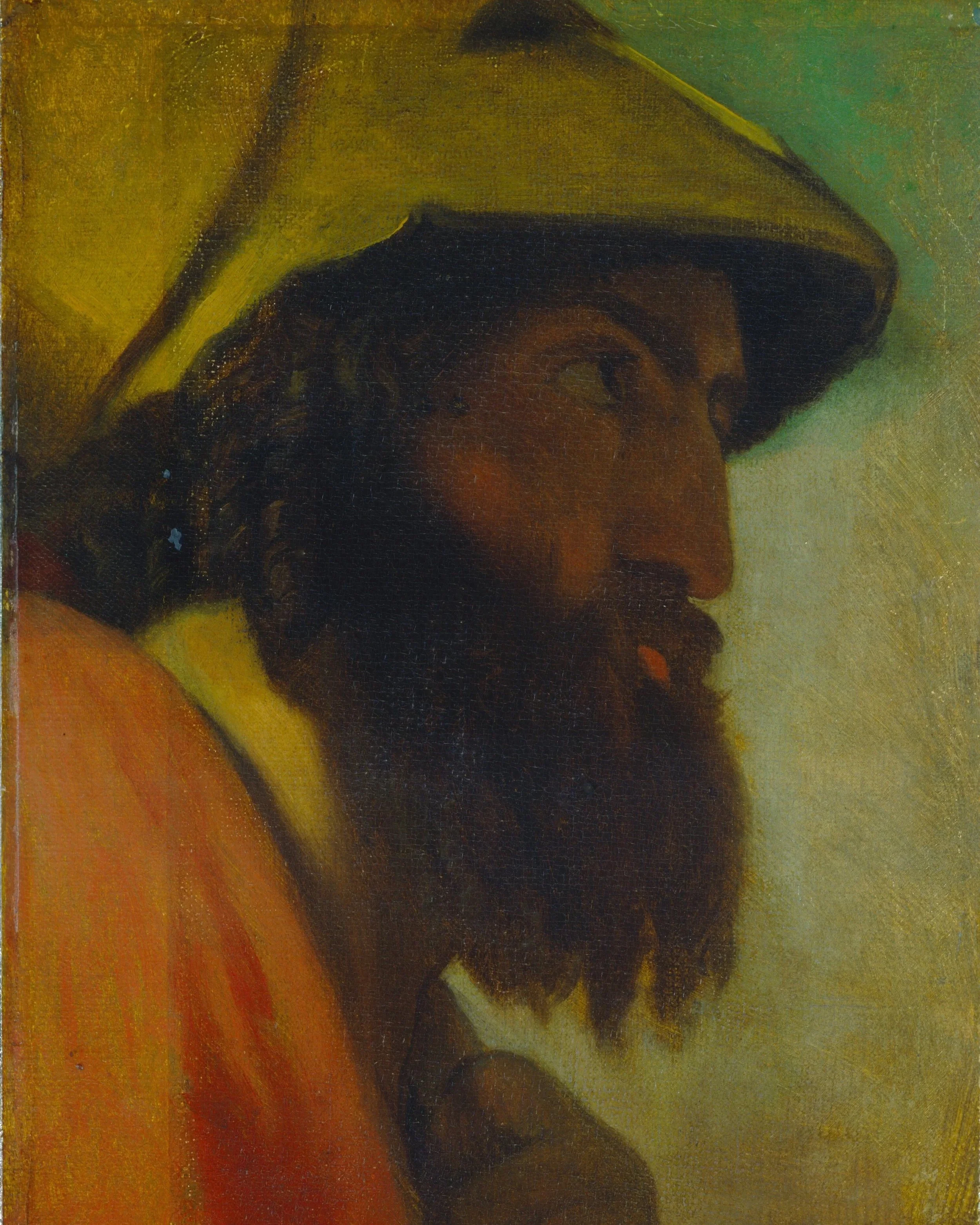
Jean-Auguste-Dominique Ingres, Ulysses, oil on canvas, 1827. (Photo: National Gallery of Art)
This article is the third in a series of reviews of and reflections on Christopher Nolan’s 2026 film The Odyssey. Reviews do not necessarily reflect the views of the editors.
Warning: Lots of Spoilers
Narrative has the power to arrestingly embody the breadth and depth of truth. It can awaken the conscience in ways that cold, rational axioms do not. Indeed, this is narrative’s great advantage, whether in film, in written form, or even in a whole life lived. Christopher Nolan’s interpretation of the Odyssey is no different on this score. Nolan’s films never waste an opportunity to engage deeply with questions of the human condition, of good and evil, of moral accountability and social consequences. In The Odyssey, however, Nolan takes a decidedly more theological turn.
Nolan’s Odyssey follows roughly the same structure as Homer’s—we are introduced first to Odysseus’s son Telemachus (Tom Holland), his wife Penelope (Anne Hathaway), and the suitors; then to Odysseus himself (Matt Damon) as he pieces together his past on Calypso’s island; and finally we see Odysseus’s return home and slaying of the suitors. Nevertheless, Nolan’s “Odysseus” is not Homer’s, and his portrayal of Odysseus’s adventures are quite different. Nolan’s story is one of humanity’s fall, akin to Genesis 3, of the breaking of the natural law and thus of God’s eternal law, and of humanity’s inability to atone for and make right this sin.
The Haunted Odysseus and the Fall of Ithaca
Nolan’s Odysseus is precisely not a trickster like Homer’s. He is initially depicted as a just man who loves his family and who even drafts his army with compassion. When hunting he always plucks his bow first to alert his prey. When reproached for this he says that hunting is “fighting with stealth” and not really fair. Odysseus gives his prey the chance of a fair fight.
Religion is a central theme of the film. The gods and their laws are real for Odysseus and the other characters. They are not played as fictions. Odysseus regularly speaks to Athena (Zendaya), complaining when he cannot understand her guidance. Moreover, religious xenia has a central role in the film as “Zeus’s law.” Xenia for the ancient Greeks was the mutual moral obligation of hospitality and respect between host and guests. For the ancient Greeks everyone should treat guests well since the gods at times appear in the guise of strangers. The Judeo-Christian tradition itself is also aware of this concept, as is evident when Abraham entertains angels unknowingly (referenced later in Hebrews 13:2). After the first mention of “Zeus’s Law,” however, Nolan collapses xenia into the Golden Rule of Christ and the Prophets: “treat others as you would have them treat you.” This is no minor change. In the first Greco formulation, guests are welcomed because they might not be human. In the second formulation, guests are to be welcomed precisely because they are.
“Nolan’s Odyssey speaks to our present moment where so many (whether on the ‘left’ or ‘right’) seem consumed by the notion of victory at any cost or even counsel “Machiavellian means for Aristotelian ends.” The wall you tear down may be your own.“
“Zeus’s Law” is Nolan’s stand-in for the natural law—those standards of morality knowable by reason and present to greater and lesser extents in every society. All of the law and the prophets are summed up in this: love the Lord your God with all your heart, mind, soul, and strength and love your neighbor as yourself (Mark 12:29-33). In short, love of neighbor is inseparable from love of God. Conversely, to sin against neighbor is also to sin against yourself and against God. Breaking “Zeus’s Law”—sinning against neighbor—is thus no mere private affair but a rupture with reality, implicating everyone and everything.
This concept of sin is at the heart of the film. Odysseus is haunted by the Trojan War and the way in which the Greeks won it. The film shows the crucial moments. The Greeks seemingly withdraw from battle and, in honor of Athena, leave a gift of peace and hospitality for the Trojans (the Trojan Horse). Exclaiming that the war is over, the Trojans erect it in their temple with great effort. It is their undoing, as the Greeks use this false token of peace to enter and conquer the city. In deceiving the Trojans with stealth and manipulating their own piety, Odysseus declares, we “turned the fight into a hunt.” Odysseus treats the Trojans as he would never treat a wild beast. But it is they, the Greeks, who have been undone and become beastly. Intensely aware of this, Odysseus says of himself, “To burn the walls of Troy was to burn the world-entire, including his home [...] What if he knew what he had done?” His idea, his opening of the gates of Troy, his out of character trick was “to break Zeus’s law forever.” “We lived in a world of palaces, trade, language, blind to its beauty until we broke it,” he declares.
The fall of Troy is simultaneously the fall of Ithaca, the triumph of inhumanity over law and wisdom. This tragic realization repeatedly reasserts itself in Odysseus’s recollection of the decapitation of the statue of Athena. To win the battle Odysseus was prepared to tear down anything and everything. The effects naturally do not remain merely at Troy. The film shows that at every moment the corruption is spreading. The suitors offend hospitality in Ithaca. Every place Odysseus and his comrades land, Zeus’s law is not respected, whether it be by the cyclops, the Laestrygonians, Circe, or Calypso. Odysseus’s own men too will not keep Zeus’s Law. In spite of all his efforts to save his men, Odysseus is warned by the prophet Tiresias, “you cannot save them from themselves.” Like the Fall in Genesis 3, once it is begun Odysseus is powerless to stop the spread of the corruption caused by his breaking Zeus’s law forever. He and his company are the feared and nameless Sea People come to cause the downfall of Bronze Age society. Indeed, so deep is the increasing transformation that by the time that Odysseus arrives home, he does not recognize Ithaca until Athena tells him. Moreover, to avoid being killed himself, he must walk as a stranger in his own changed land. Odysseus eventually slays the suitors but it remains clear that something more is needed than what Odysseus can provide. Odysseus—indeed, humanity—needs something more than stronger self-will. Who will save us from ourselves?
Nevertheless, Nolan’s sin-haunted Odysseus does undergo a repentance of sorts. In order to get home, Odysseus is encouraged to give himself up to the waters he has been fighting, to let go of his need to be in control, and to have faith. With clear baptismal overtones, Odysseus is repeatedly washed by waves. Following this, there is a scene that, for those familiar with the Catholic faith, recalls the sacrament of confession, complete with a grille. Odysseus speaks to Penelope but addresses his words to the goddess of wisdom, Athena. Moreover, the music of Odysseus’s confession is the haunting song of the Sirens. It is the song, Odysseus describes earlier, that tells you, “what you most want is what you most can’t have and that the most you can’t have is what you already had and lost.” Odysseus confesses what he has lost, what he has done to the world, and what he can never again recover. This final confessional encounter with Athena puts the rest of the film into context. The audience sees the final moments of the burning and sack of Troy. In a moment doubtlessly meant to recall the death of Cassandra from The Illiad, one of Athena’s priestesses (Zendaya) is murdered at the temple right in front of Odysseus. The gory moment is not shown, as she is beheaded in the same moment that Athena’s statue is.
It is at this moment that Athena’s messages to Odysseus throughout the film suddenly becomes clear. Athena has appeared to Odysseus throughout the film in the form of this priestess. When Odysseus repeatedly complains that the gods do not speak in ways humans understand, Athena asks him, “who doesn’t understand fire, a child’s smile, [...] pain, or blood, or death?” She speaks with the visage of the slain priestess and asks who is responsible for the sea or for the birds’ natural flocking together? Athena’s message is clear. The gods do play a role, but Odysseus is the one responsible for his suffering, for his being lost from Ithaca, for not being in harmony with the rest of reality: the gods, the world, other people, and himself. The moral law, “Zeus’s law,” places the order of our hearts in harmony with the order of reality. Both divinity and the natural law are knowable through the world; it is Odysseus who cannot abide them. The internal harmony of morality parallels the external harmony of reality. And the disharmony of the microcosm (the soul) creates the disharmony of macrocosm (the world).
The film’s greatest strength lies in its thematic reflection on sin and the disharmony it creates, both interiorly and exteriorly. Nolan also underplays the sexuality and gore that could easily have been part of the film, instead favoring a more reflective and thoughtful tone that supports the thematic elements. This is perhaps most evidently seen in Odysseus’s encounter with the Sirens and their musical callback later in the movie. Nolan also strongly leans into practical effects over CGI, not only for his monsters but also for Troy and Odysseus’s actual ship at sea. Such preferences ground the moral and theological themes—making them feel real, present, and tangible even when giant monsters and gods appear beside the main characters. At times, however, the film suffers from an uneven script. This severely hampers the scenes with the suitors, and most especially Antinous (Robert Pattinson). Nevertheless, the film takes its characters seriously, especially Odysseus as a man, and strongly cautions against a “win at any cost mentality” over one’s “enemies.” In this way, Nolan’s Odyssey speaks to our present moment where so many (whether on the “left” or “right”) seem consumed by the notion of victory at any cost or even counsel “Machiavellian means for Aristotelian ends.” The wall you tear down may be your own.
The strangest part of Nolan’s film, however, is the ending. Homer ends his account with Odysseus ruling Ithaca in a new peace that Athena establishes and which Odysseus is not able to achieve through sheer force of arms alone. By contrast, Nolan’s Odysseus is exiled from Ithaca. The film ends as Odysseus begins a second voyage “chasing the escaping sun” with Penelope and a new crew. Either ending could have fit with the overall themes of the film. But Nolan’s formerly haunted Odysseus is portrayed in the end as somewhat hopeful. Perhaps Nolan wanted to give the audience, and Odysseus, a happy ending despite setting his film explicitly during the collapse of the Bronze Age. Nevertheless, it feels somewhat jarring and perhaps like a misstep. After Odysseus’s previous confession to Penelope about what he had done and what he cannot restore, Nolan’s film ends with Penelope declaring “Civilization will rise again” and Odysseus responding, “And dawn will break over the darkened world, and our mistakes will once again be forgotten.” This jarring ending leaves the audience with some combination of three possible interpretations. Firstly, Nolan’s Christian background may be surfacing, and, like the earlier visual references to sacraments, this could be a typological foreshadowing of the coming of Christ the Redeemer:
“The people who walk in darkness have seen a great light.
Upon those who lived in the land of gloom a light has dawned.” (Isaiah 9:1–2)
Secondly, Penelope and Odysseus, faced with the fact that their society is doomed and their son has been left alone to face it, might be trying to find some solace in the pagan cyclical view of history as eternal return. Lastly, Nolan might be weaving in Dante’s account of Odysseus from Canto XXVI. Dante’s Ulysses takes a second voyage, rousing his crew with a speech to seek the land beyond the sun and beyond the Pillars of Hercules. It is one more example of Odysseus wrongly leading people against the laws set by the gods. It leads to their deaths and lands him in Dante’s Hell. Is Nolan depicting a future and ultimate fall for a hubristic Odysseus, or is this something else? Have Odysseus’s own mistakes once again already been forgotten?
Conclusion
On the whole, Nolan’s The Odyssey is another interesting and thoughtful addition to his body of work. In typical Nolan fashion it asks deep questions (e.g., “who will save the crew from themselves?” “What are the consequences of breaking ‘Zeus’s Law?’ ”) and does not always present ready-made answers to the audience. It is strongest when Odysseus’s downfall is seen as a narrative type for humanity’s larger brokenness (not unlike Genesis 3) and when it examines the natural law and our inability to save us from ourselves. Indeed, the ambiguous ending itself leaves the audience wondering what happens to Odysseus as he embarks on his second, and seemingly last voyage. In what ways does Odysseus too need saving from himself?
In the final analysis, Nolan’s interpretation of The Odyssey is an insightful and worthwhile one. The film is hampered by an uneven script that mars some of its virtues, but Nolan nevertheless crafts scenes that strike the heart, such as Odysseus’s torturous encounter with the Sirens or his confession to Penelope and Athena. His Odysseus is a beguiling character, even if not a trickster. And yet, it is precisely in the strangeness and familiarity of Odysseus’s sin-haunted story that its strongest themes are found.