When investment is with strong and reliable partners and allies such as France, Canada, the United Kingdom, Ukraine, Poland, and Japan, the American public can trust that our investment will benefit them and opportunities arise for Americans to travel and work in these countries. But when investment is with highly unstable authoritarian countries such as Russia, Venezuela, China, and Cuba, this harms Americans, as these countries continue to act against their own people, neighboring countries, and the United States.
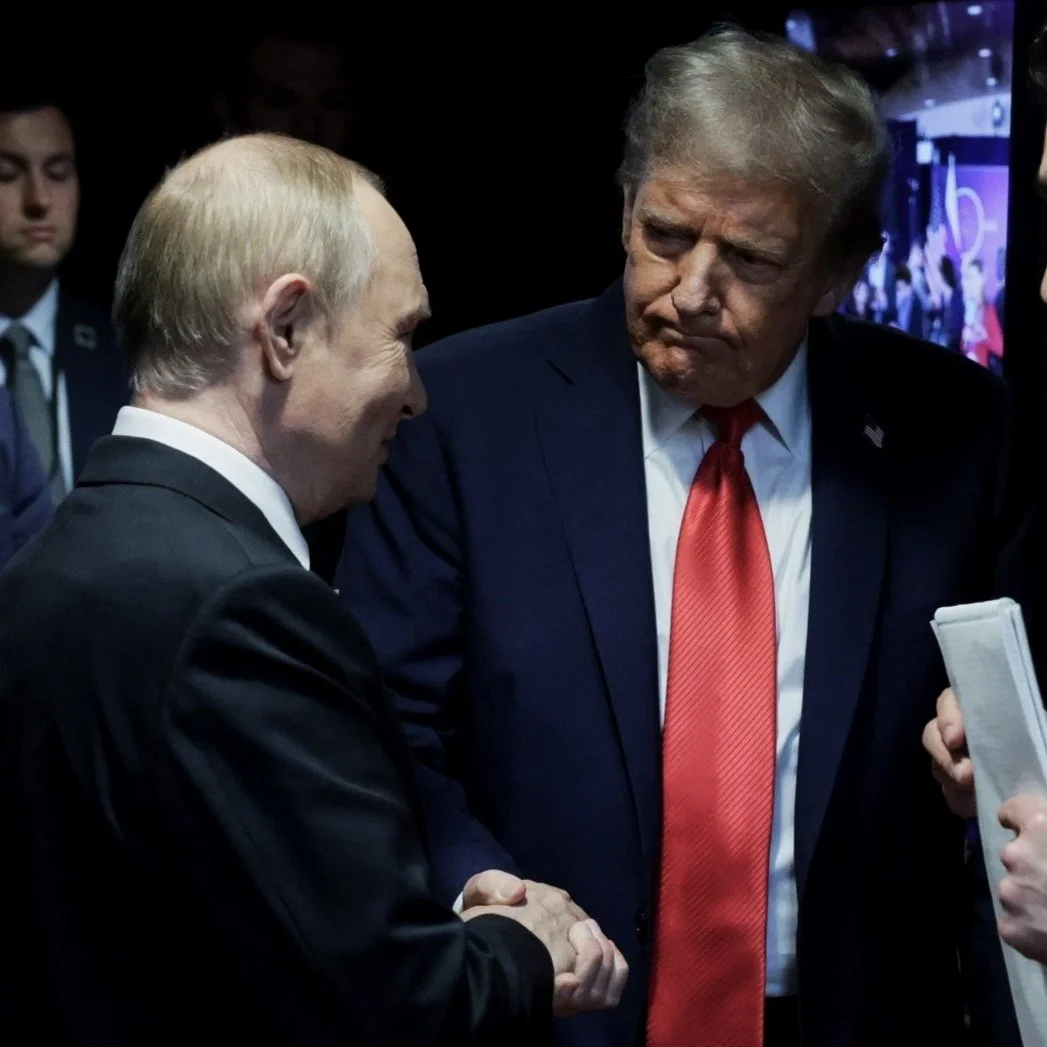
Donald Trump and Vladimir Putin after a joint news conference during the 2025 Russia–United States Summit in Anchorage, Alaska. Photo by Kremlin.ru, via Wikimedia Commons, licensed under CC BY 4.0.
In 2022 Russia led a full-scale invasion of Ukraine. It was not alone: Iran, China, Venezuela, Cuba, and other countries, which became known as the “alliance of autocracy” or “axis of autocracy,” joined in various ways. Against that backdrop, the new diesel deal is troubling. It is a clear example of American investment in Russia—a country actively participating in armed conflict and one that considers itself an enemy of the United States. When American companies invest in nations in the alliance of autocracy such as Russia, Venezuela, Cuba, or China, the money often goes into the regime’s own networks and is used for the war in Ukraine, or efforts to sabotage the United States and our allies. Such support for Russia, China, Iran, and Venezuela only harms American investors and our long-term standing in the world.
Russia is not a reliable partner to the United States, and it cannot be. (Canada, a reliable ally with oil reserves, is a clear alternative.) Russia is actively seeking to sabotage the American water supply and is polarizing our political space with bots and cyber warfare. China, for its part, is buying up American farmland. Appeasing authoritarian powers will not result in stability but only confusion on the world stage.
And unlike what some commentors suggest Russia and China cannot be separated; they are too intertwined. Rebeccah Heinrichs and Senator Rick Scott highlighted the immense dangers of retreat. Before the invasion, Russia and China signed a joint declaration against what they call “American Color Revolutions,” which were pro-democracy movements in Eastern Europe and Central Asia. Russia and China want to divide the United States and Europe and push us into their spheres of influence, that is, a geopolitical sphere of political and economic influence by connected allies. This spheres-of-influence ideology is quite dangerous. Authoritarian powers are thus acting less like they did in the Cold War and increasingly in tandem, as one solidified empire.
Continuing to treat Russia and China as separate spheres is not only naïve—it is dangerous. These countries are communicating through diplomatic and military channels. Iran is actively supplying Russia with drones to invade Ukraine, as countries like Venezuela teach psychological warfare to Russia and China, including how to manipulate and divide the civilian populations by causing large-scale cognitive dissonance and learned helplessness. Venezuela has perfected the art of manipulating public opinion and condensing time,* causing people to elevate and discard opposition leaders instead of unifying against the regime. Removing Maduro but keeping Delcy Rodriguez in power (while Delcy continues to carry out the same actions as Maduro such as seizing an opposition leader’s home and stealing all his books, children’s toys, and even his dogs) shows that this strategy of not truly understanding autocrats is creating tremendous instability and risks for investors.
Relationships are everything, which means that reputation is paramount. In addition to historic political alliances, Americans overwhelmingly value our friendship with Europe. This is evidenced by how young Americans seek to study and work in Spain, France, and Germany. Baltic Countries like Lithuania, Latvia, and Estonia, moreover, supply muscle power to NATO, along with major rising powers such as Poland.
Abandoning our allies destroys the diplomatic relations we spent years cultivating. Ukraine is standing literally on the frontlines between the alliance of autocracy and the free world. If they win, they have a potential to be a major American diplomatic power, supplying us with valuable resources. Ukraine, being in the technological belt of Europe along with Poland and the Baltics, can supply us with technology and software. Ukraine has also mastered the art of drones and robotic warfare, which as per Anne Applebaum will revolutionize our defense industry, as well as their sharp intelligence operations.
As for natural and industrial resources, however, the United States is so large that we need not rely on countries such as Russia who are actively at war with us. Moreover, investors and businesspeople want stability and predictability. Investing in countries with no rule of law, where property is seized arbitrarily, neighboring countries are invaded, and political opponents are arrested carries high risk. It does not benefit American interests to become close to these countries, and if anything is a net negative for us.
American public opinion is also overwhelmingly in support of Ukraine often cited between 70 percent in favor. The Lindsay Graham sanctions package was recently passed in congress and signed by President Trump as a major legislative priority. It makes no strategic sense to go back on the one issue that unites Americans on both sides of the aisle.
Standing with Ukraine is not just a moral issue, nor is it mere activism. Standing with Ukraine is a geopolitical strategy in favor of US Interests. When countries such as Russia, Iran, Venezuela, Cuba, and China are acting in tandem to buy up American and European farmland, investing millions into bot farms to polarize our societies and divide us from our allies in Europe, and conducting sabotage operations and transnational repression, it is in American interests to not fund or invest in these countries. They are actively seeking to discredit and destroy us and our credibility.
We cannot disengage from the world; that would be just as naive and shortsighted. The most “America First” strategy that would make sense is to invest in our strongest historical allies such as Poland, the Baltics, France, and Canada. These are the countries with whom we already have long established diplomatic relations and mutual concerns. We need to actively aid Ukraine in fighting Russia and not invest in Russia, since that brings little long-term benefit to investors and damages America’s geopolitical standing. When investment is with strong and reliable partners and allies such as France, Canada, the United Kingdom, Ukraine, Poland, and Japan, the American public can trust that our investment will benefit them and opportunities arise for Americans to travel and work in these countries. But when investment is with highly unstable authoritarian countries such as Russia, Venezuela, China, and Cuba, this harms Americans, as these countries continue to act against their own people, neighboring countries, and the United States. With the authoritarian countries actively engaged in cognitive warfare, we need to react to the moment we have now and fully support Ukrainian victory and strengthen our current alliances.
· Condensing time is a psychological tactic often employed by authoritarian regimes in which they treat major opposition victories as the “distant past” in an effort to turn public opinion against the opposition.